
 Email Us
 Contact us
 Whats App
Single family home

Choosing the right battery can affect how you use solar energy at home. The Top 10 Batteries for solar energy systems help you save money. They also help you become more independent with your energy. Many U.S. homes save about 15% on electricity costs with a solar-battery setup. You should check performance, chemistry, capacity, warranty, cost, and compatibility. Brands like BEINENG Home ESS and other top brands have smart features and good storage. With the right choice, you get more control over your power and your future.
Picking the right solar battery can help you save money. It can also help you use less power from the grid. Think about important things like how well the battery works, how much energy it holds, the warranty, and if it works with your system. Some batteries, like BEINENG Home ESS and Tesla Powerwall 3, have smart features. They also give steady backup power. Check how much energy your home uses and what your local power rates are. This will help you pick the best battery size for your house. Choose batteries that last a long time and have good warranties. This will help you get the most value over time.
You want the best battery for your solar energy system, but there are so many choices. Here’s a quick look at the Top 10 Batteries that stand out for performance, reliability, and smart features. Each one brings something special to the table, whether you need backup power, high capacity, or easy expansion.
BEINENG Home ESS – All-in-one solar, storage, and EV charging with smart app control.
Tesla Powerwall 3 – Trusted name, high efficiency, and easy to stack for more power.
Bluetti EP900 Home Battery Backup – Flexible and strong for backup needs.
Enphase IQ 5P – Modular design and great for grid-tied systems.
Qcells Q.SAVE D20.0SX – Reliable LFP chemistry and solid warranty.
HomeGrid Stack'd Series – Stackable for big homes or growing needs.
BYD Battery-Box Premium – Flexible capacity and strong safety record.
LiFePO4 Battery Systems – Long lifespan and stable performance.
LG Chem RESU Prime – Compact, efficient, and proven in the field.
Generac PWRcell – High power output and good for whole-home backup.
Tip: If you want to see how these batteries compare in usable capacity, check out the chart below!
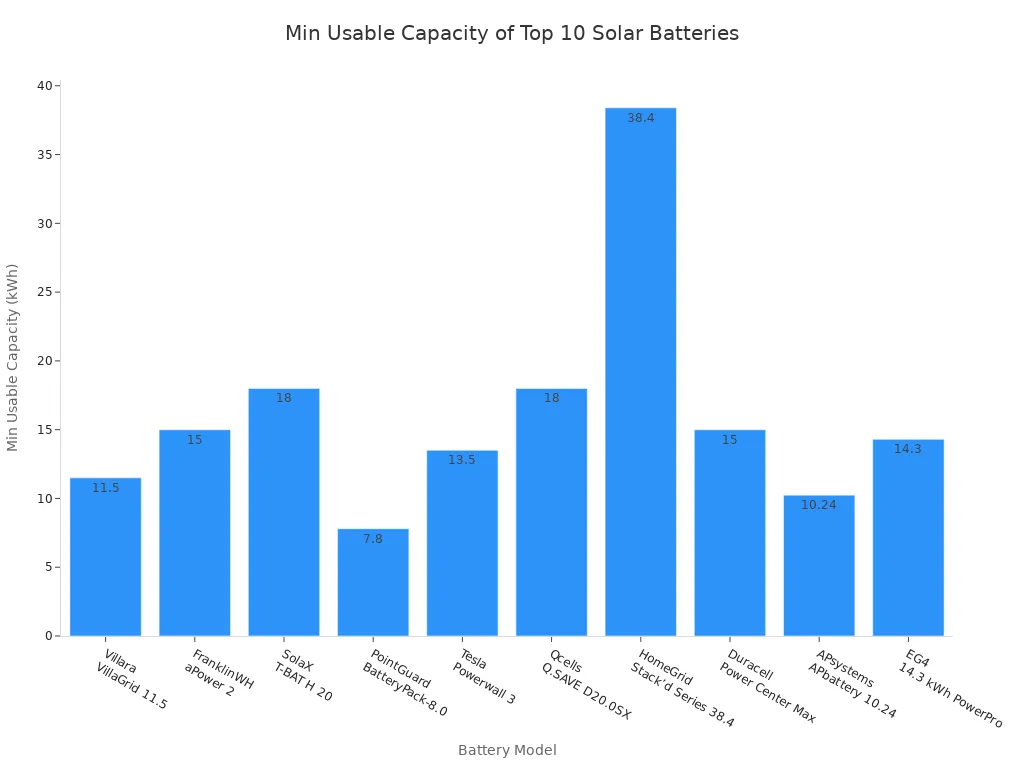
Here’s a handy table to help you compare the Top 10 Batteries by key specs. You can spot the differences in chemistry, capacity, warranty, and more at a glance.
Battery Model | Chemistry | Power Rating | Usable Capacity | Roundtrip Efficiency | Warranty |
|---|---|---|---|---|---|
BEINENG Home ESS | LFP | 5-10 kW | 10-40 kWh+ | 95%+ | 10 years |
Tesla Powerwall 3 | LFP | 7 kW | 13.5 kWh | 97.5% | 10 years |
Bluetti EP900 | LFP | 9 kW | 19.8 kWh | 90% | 10 years |
Enphase IQ 5P | LFP | 3.84 kW | 5 kWh | 96% | 15 years |
Qcells Q.SAVE D20.0SX | LFP | 10 kW | 18 kWh | 94% | 10 years |
HomeGrid Stack'd Series | LFP | 7.6 kW | 38.4 kWh | 96% | 10 years |
BYD Battery-Box Premium | LFP | 5-10 kW | 13.8 kWh | 95% | 10 years |
LiFePO4 Battery Systems | LFP | 5-10 kW | 10-20 kWh | 95% | 10 years |
LG Chem RESU Prime | NMC | 5 kW | 16 kWh | 94.5% | 10 years |
Generac PWRcell | LFP | 8.6 kW | 18 kWh | 96% | 10 years |
You can use this table to match your needs with the right battery. The Top 10 Batteries offer a range of options, so you can find the perfect fit for your home and lifestyle.
When you choose a solar battery, you will see different chemistry types. The most common ones are Lithium Iron Phosphate and Nickel Manganese Cobalt. Each type has its own good points. Look at this table to see how they are different:
Feature | LFP (LiFePO4) | NMC |
|---|---|---|
Safety | Excellent | Good |
Thermal Runaway Temp | ~270°C | ~210°C |
Cycle Life | Up to 5,000 cycles | |
Energy Density | 90-160 Wh/kg | 150-220 Wh/kg |
Cost | Lower | Higher |
Common Use | Home storage, buses | EVs, electronics |
LFP batteries are very safe and last a long time. They can work in high heat and last up to 10,000 cycles. NMC batteries hold more energy in a smaller size, but they do not last as long.
You need a battery that fits your energy use. Most home solar batteries store between 3 kWh and 15 kWh. This is enough for many families each day. Always check the usable capacity, not just the rated number. Usable capacity shows how much energy you can really use.
Tip: A bigger battery lets you store more solar energy and use less from the grid.
Efficiency means how much energy you get out compared to what you put in. The best batteries today reach 90% or more round-trip efficiency. This means you keep most of the energy you store. Lifespan is important too. LiFePO4 batteries can last 15 to 20 years and work for thousands of cycles before losing much power. NMC batteries usually last for fewer cycles.
100% Depth of Discharge: 2,000–4,000 cycles
80% Depth of Discharge: 5,000–7,000 cycles
50% Depth of Discharge: 10,000–15,000 cycles
Most top solar batteries have a 10-year warranty. This means you will have at least 70% of the starting capacity left at the end of the warranty. Some brands give longer coverage or extra promises.
Warranty Length | Coverage Details |
|---|---|
10 years | Standard coverage against product defects |
Up to 20 years | Premium options available |
End-of-warranty | 70% capacity retention is typical |
When you look at cost, check both the price per kWh and the total value over time. Lithium batteries cost $200 to $400 per kWh, but they last longer and need less care. This means you save more money in the long run.
You want a battery that does more than store energy. The BEINENG Home ESS gives you a full solution for your house. It has solar power, battery storage, and EV charging in one system. The design looks modern and has eagle eye lighting. You can install it fast with easy pin connectors. The battery packs stack, so you can start small and add more later. You control everything with the myBeineng app. The app helps you manage energy and see your savings.
Here’s what makes BEINENG special:
Feature | Description |
|---|---|
Design | Stylish eagle eye and side lights blend with your home. |
Integration | Combines solar inverter, EV DC Charger, Battery PCS, Battery Pack, and EMS in one device. |
Battery Capacity | Each stack holds 5 to 48 kWh. You can use it for homes or businesses. |
Safety | Five layers of battery safety and system safety. |
Installation | Easy setup with pin connectors. Stack batteries in 15 minutes. |
System Commissioning | Auto networking and auto-diagnosis finish in 5 minutes after turning on. |
AI Integration | Uses AI for better energy management and VPP features. |
You get quick setup, strong safety, and smart energy control. BEINENG works for homes and small businesses. You can use it for solar storage, backup power, or EV charging. If you want a battery that grows with you, BEINENG is easy to use.
Tesla Powerwall 3 is a top pick in the Top 10 Batteries. It gives high power and is good for backup power. The Powerwall 3 is all-in-one, so you do not need extra parts. You can install it fast and start saving energy. The Tesla app lets you see and control your battery from anywhere.
Here are the pros and cons:
Pros | Cons |
|---|---|
All-in-One System | Only works with single-phase power |
High Power Output | One main part can fail |
Large Solar Input Capacity | Hard to use with old systems |
Quick, Efficient Installation | Higher voltage can be risky |
Intelligent Energy Management | Warranty is shorter than microinverters |
Reliable Backup Power | Big and heavy |
Expandable Storage Capacity | |
Bundled Value for New Installs | |
Durable and Weatherproof | |
Built-In Safety Features |
You get strong backup and easy app control. The Powerwall 3 is best for homes that want a simple battery. If you want to expand, you may need modular options.
Bluetti EP900 gives you flexible and strong backup power. You can use it during outages or save solar energy. The EP900 is modular, so you can add more batteries later. You get energy independence and can power many appliances.
Best ways to use it:
Energy independence for your house
Backup power for appliances
Modular storage for growing needs
If you want a battery that changes with your life, Bluetti EP900 is smart.
Enphase IQ 5P is a modular battery. You can start with one and add more if you need. Each battery gives 5 kWh, and you can expand easily. The IQ 5P works with the Enphase IQ EV Charger. You can use solar energy to charge your car and use less grid power.
Feature | Description |
|---|---|
EV Charging Support | Works with Enphase IQ EV Charger to use solar energy for charging and use less grid power. |
System Expandability | Modular design lets you start with one battery and add more as you need. |
You get flexible and smart energy use. The IQ 5P is great for homes that want to grow their solar system.
Qcells Q.SAVE D20.0SX gives reliable energy storage and high efficiency. You get 18 kWh of usable energy and up to 11.1 kW power. The round trip efficiency is 95%, so you keep most stored energy.
Metric | Q.SAVE D20.0SX |
|---|---|
Usable energy | 18 kWh |
Round trip efficiency | 95% |
Maximum power output | 11.1 kW |
You can use Qcells for daily savings or backup. It works well for families who want a strong battery.
HomeGrid Stack'd Series is made for easy expansion. You can add more in 4.8 kWh steps, so you only buy what you need. The plug-in design makes setup fast and upgrades simple. You do not need extra wires between modules.
Feature | Description |
|---|---|
Scalability | Modular design lets you expand and customize storage. |
Maintenance | Easy because of plug-in design and light modules. |
Installation Time | Setup takes less than 30 minutes. |
Capacity | Each module is 4.8 kWh. You can have up to 576 kWh total. |
Upgradeability | No wires needed between modules, so upgrades are easy. |
Expandable in 4.8 kWh steps
Good for homes, small businesses, and off-grid setups
Fast setup and easy care
If you want a battery that grows with you, HomeGrid Stack'd Series is a great choice.
BYD Battery-Box Premium is popular for off-grid solar systems. You get high discharge capacity, so you can run your home without the grid. The modular design lets you change your storage. BYD uses cobalt-free LFP chemistry for better safety and longer life.
Advantage | Description |
|---|---|
High Discharge Capacity | Lets you run without the grid, good for off-grid homes. |
Modular Design | Lets you change and grow storage as needed. |
Safety and Longevity | Uses cobalt-free LFP chemistry for safety and long life. |
Efficiency in Energy Consumption | Helps you use your own renewable energy, which saves money as subsidies go down. |
Great for cabins, backup, and remote homes
Works with hybrid or battery inverters
Safe and lasts a long time
BYD is smart if you want off-grid power.
LiFePO4 battery systems give strong safety and long life. You get high thermal stability and low fire risk. These batteries last thousands of cycles, so you save money. LiFePO4 is better for the planet because it does not use cobalt or nickel.
Feature | LiFePO4 | NMC/NCA |
|---|---|---|
Thermal Stability | High | Moderate |
Cycle Life | 3,000–5,000+ cycles | 1,000–2,000 cycles |
Fire Risk | Low | High |
Environmental Impact | Lower (no cobalt/nickel) | Higher (contains cobalt) |
If you want a battery that is safe and lasts, LiFePO4 systems are a good pick in the Top 10 Batteries.
LG Chem RESU Prime is small and efficient. You get a battery that fits in tight spaces but still works well. The warranty lasts up to 10 years if you connect to the internet and use a certified installer.
Warranty Condition | Duration |
|---|---|
With internet connection and certified installation | 10 years |
Without internet connection | 5 years |
Warranty after RMA replacement | Stays the same as before |
Warranty start time | After install or 36 months from production date (for units installed before 2023) |
You can use LG Chem for daily savings or backup. It is good for homes with little space.
Generac PWRcell gives high power and smart home features. You can connect it to ecobee smart thermostats to manage energy during outages. The system changes your temperature settings to save battery life. You get real-time updates on energy use and battery status.
Feature | Description |
|---|---|
Compatibility | Works with ecobee smart thermostats for better energy control. |
Monitoring | Shows battery status and outage details on the thermostat. |
Automatic Adjustments | Changes temperature during outages to save battery. |
Better monitoring during outages
Automatic changes to save battery life
Real-time info on energy use
Generac PWRcell is great if you want smart features and strong backup.
Tip: The Top 10 Batteries have something for everyone. You can find a battery for your home, budget, and energy needs. Look for modularity, app control, and expandability for the best value.
You need a battery that fits your solar system. Think about what you want from your energy. Do you want backup power, lower bills, or more freedom? Look at how you use electricity each day. Check when you use the most power and how it changes in different seasons. Your local utility rates are important too. Some utilities give you full credit for extra solar power. If you get full credit, a small battery might be enough. If you get less credit, a bigger battery can help you save more.
Set your energy goals.
Look at your daily power use.
Learn about your utility rates.
If your utility gives full credit, you may only need a small battery. If you get less credit, a bigger battery is better. If there is no net metering, pick a battery that can store all your extra solar power.
Will you go off-grid or stay on the grid? Off-grid systems need batteries to store energy for cloudy days and nights. You will need more storage and pay more upfront. Grid-tied systems use the grid when solar power is low. Batteries are not required for grid-tied systems.
System Type | Extra Info | |
|---|---|---|
Off-Grid | Yes | Stores extra energy for times with less sun. |
Grid-Tied | No | Uses grid power when solar is not enough. |
Off-grid systems need bigger batteries and more planning. Grid-tied systems are more flexible and cost less.
Your budget matters when picking a battery. Think about the total cost, not just the price. Look at how much you can save over time. Batteries that last longer and work better often give you more value. If your utility rates are high, a bigger battery can help you save more money.
Tip: Pick a battery that fits your needs and budget. It will help you save money over time.
Plan for installation and care. Most batteries need a professional to install them. Costs include labor ($1,000–$2,000), extra equipment like inverters ($1,000–$1,500), and monitoring systems ($200–$500). Maintenance costs $150–$300 each year. If you upgrade or change your system, expect to pay $1,000–$2,000.
Cost Part | Estimated Cost |
|---|---|
Labor for Installation | $1,000 – $2,000 |
Extra Equipment | $1,000 – $1,500 |
Monitoring System | $200 – $500 |
Yearly Maintenance | $150 – $300 per year |
Upgrade Costs | $1,000 – $2,000 |
Pick a battery that is easy to install and care for. This helps your system work well and saves you trouble later.
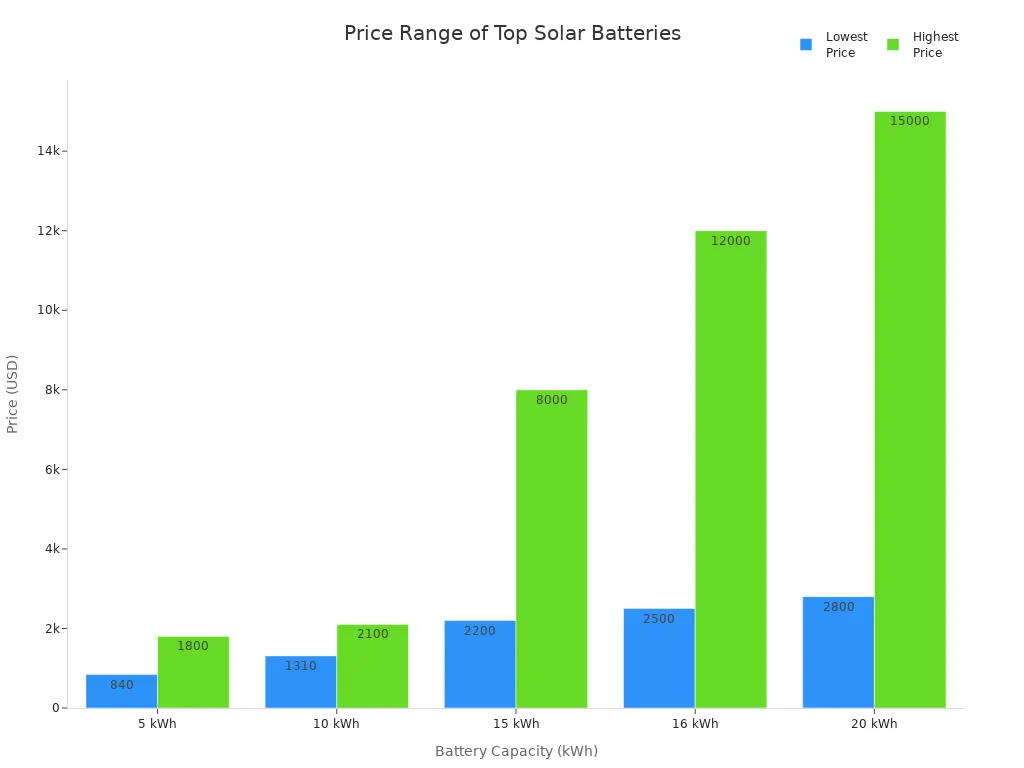
When you shop for a solar battery, price matters a lot. You want to know what you get for your money. Solar batteries come in different sizes and prices. Some work best for small homes or campers, while others can power your whole house. Here’s a table to help you see the price range for popular battery sizes:
Capacity | Price Range (USD) | Typical Cycle Life | Notes |
|---|---|---|---|
5 kWh | $840–1,800 | ~6,000–8,000+ cycles | Good for small homes, campers, backup. |
10 kWh | $1,310–2,100 | 10+ years (≥6,000 cycles) | Widely used for whole-house backup. |
15 kWh | $2,200–8,000 | ≥6,000 cycles common | Often assembled from smaller modules. |
16 kWh | $2,500–12,000 | ≥6,000 cycles common | Popular for DIY large-capacity builds. |
20 kWh | $2,800–15,000 | 10–15 years | Whole-home backup, off-grid systems. |
You can see that bigger batteries cost more, but they also last longer and store more energy. The price depends on the brand, features, and how many cycles the battery can handle.
Tip: If you want to save money over time, look for batteries with a high cycle life and a good warranty.
You want your battery to last and give you the best value. Most lithium-ion batteries last 10 to 15 years and need little care. Lead-acid batteries cost less at first, but they need more work and do not last as long.
Battery Type | Lifespan (Years) | Maintenance Level |
|---|---|---|
Lithium-ion | 10–15 | Lower maintenance required |
Lead-acid | 3–7 | Higher maintenance needed |
Several things affect how long your battery lasts and how much value you get:
Temperature
Maintenance practices
Quality of the battery
Usage patterns
If you use your battery the right way, you can make it last longer. Keep it in a cool place and follow the care tips from the maker. A good battery gives you more savings and fewer worries for years.
If you want a battery that does it all, choose the BEINENG Home ESS. You get solar energy storage, backup power, and fast EV charging in one system. The myBeineng app lets you control your energy from your phone. You can start small and add more batteries as your needs grow. The BEINENG Home ESS works well for most homes and small businesses. It gives you safety, smart features, and easy installation.
Looking for the best deal? The BYD Battery-Box Premium gives you strong performance and a long lifespan without a high price. You can change the size of your system as your needs change. The battery uses safe LFP chemistry and comes with a solid warranty. You save money over time because it lasts for many years.
If you want backup power during outages, the Tesla Powerwall 3 is a smart pick. It gives you high power output and reliable storage. The Tesla app helps you see your battery status and control your system from anywhere. You get peace of mind when storms or blackouts hit.
Do you live far from the city or want to cut ties with the grid? The HomeGrid Stack'd Series is a top choice. You can add more storage as your needs grow. The plug-in design makes setup fast. It works well for cabins, remote homes, or anyone who wants full energy independence.
Need a lot of power? The Qcells Q.SAVE D20.0SX gives you 18 kWh of usable energy and high efficiency. It works well for large homes or places with big energy needs. You get strong backup and daily savings.
When you pick a battery, think about your power needs, how long you want it to last, and your budget. Look at things like battery capacity, lifespan, peak power output, efficiency, and warranty. The right battery makes your solar system work better for you.
Consideration | Why It Matters for You |
|---|---|
Battery capacity | Matches your daily energy use |
Lifespan and cycles | Lasts longer, saves money |
Peak power output | Runs big appliances when needed |
Efficiency | Keeps more of your stored energy |
Warranty | Protects your investment |
Cost | Fits your budget |
You have learned how each battery works for different needs. If you want more control over your energy, think about how much power you use each day and how much you can spend. The Top 10 Batteries give you options for backup power, living off the grid, and storing lots of energy. It is smart to talk to a solar expert before you buy anything. You should also look at prices in your area and see how easy it is to get the battery installed. Choosing the right battery can help you save money and keep your house running.
Tip: Make a list of your energy goals before shopping. This will help you choose the best battery.
Most solar batteries last 10 to 15 years. You can make your battery last longer if you keep it cool and follow the care tips from the maker.
Yes, you can! Many systems, like BEINENG Home ESS, let you stack or add more batteries as your energy needs grow.
You stay powered up during outages if your system has backup features. Some batteries, like Tesla Powerwall 3 and BEINENG Home ESS, give you backup power when the grid goes down.
You need to check your daily energy use. Most homes use a 10–15 kWh battery. If you want more backup or live off-grid, you may need a bigger battery.
Yes, solar batteries use safe technology. LiFePO4 batteries have strong safety records. You should always follow the installation and care instructions for best results.


Compact, quiet, and powerful, it keeps your essentials running during outages and lets you charge anywhere with solar power or grid power.
Perfect for renters who need flexibility without compromise.
Our estimator is only set up to provide preliminary estimates and installer information to residents of single family homes.