
 Email Us
 Contact us
 Whats App
Single family home


If you want to see if a solar battery system is worth it, check the numbers. People in the United States usually save between $1,280 and $1,410 each year. It takes about 7.2 to 10.1 years to pay back the cost. The average ROI for solar batteries is around 10%. Here is a simple chart:
Metric | Value |
|---|---|
$1,280 - $1,410 | |
Payback Period | 7.2 - 10.1 years |
Average Solar ROI | ~10% |
Learning about Solar Battery Economics helps you know how much you can save and when you will start getting real benefits.
Homeowners can save $1,280 to $1,410 each year with a solar battery system. This makes it a smart money choice.
The payback period for solar batteries is about 7.2 to 10.1 years. This helps you plan your spending better.
Knowing about ROI helps you see if your investment is good. Most homeowners get about a 10% ROI on average.
Incentives and rebates can lower your starting costs a lot. They also help you save more money, so check local programs.
Tools like the myBeineng app help you watch your energy use and savings. This helps you get the most from your solar battery system.
Solar Battery Economics helps you understand how much money you can save by using a solar battery system at home. When you look at the numbers, you see how much you spend, how much you save, and how long it takes to get your money back. These facts help you decide if a solar battery is a good choice for your house.
ROI stands for Return on Investment. This number shows you how much profit you make compared to what you spend. You can use this simple formula:
Component | Description |
|---|---|
Annual Savings | The amount saved each year from using the solar battery system |
Initial Cost | The upfront cost of the solar battery system |
ROI Formula | |
Example | If Annual Savings = $1,500 and Initial Cost = $10,000, then ROI = (1500 / 10000) x 100 = 15% |
A higher ROI means you get more value for your money. Most homeowners see an ROI of about 10% with solar batteries.
The payback period tells you how many years it takes to recover your initial investment. You find this number by dividing the total cost of your solar battery system by your yearly savings. For example, if your system costs $10,000 and you save $1,400 each year, your payback period is about 7.1 years. You start saving real money after this time.
Knowing your ROI and payback period helps you make smart choices. These numbers show you if a solar battery system will save you money and how soon you will see those savings.
You want to lower your electricity bills.
You want to increase your home’s value.
You want to see if Solar Battery Economics make sense for your situation.
Many factors affect your savings, such as electricity rates, time-of-use plans, and incentives. States like California and Texas have strong support for battery storage, which can make your investment even better.
When you buy a home solar battery system, you pay for many things. You pay for installation, battery modules, and sometimes upgrades to your electrical panel. The table below shows the usual price range for each part:
Cost Component | Estimated Cost Range |
|---|---|
Installation Labor | |
Inverter (if not included) | $1,000–$1,500 |
Monitoring System | $200–$500 |
Electrical Panel Upgrade | $1,000–$2,000 |
Lithium-ion Battery | $800–$1,500 per kWh |
Lead-acid Battery | $200–$500 per kWh |
You might need a battery management system. This can cost $500–$1,500. Permitting and interconnection fees are $500 to $2,000. Big systems can cost $35,000 or more. Most people spend $150 to $500 each year on maintenance. Maintenance means cleaning, inspections, and saving money for inverter replacement. Sometimes, warranties pay for these costs for a few years.
The BEINENG Home ESS is flexible. You can start with a small system. You can add more battery modules later if you need them. The system works with new and old batteries. This helps you save money over time.
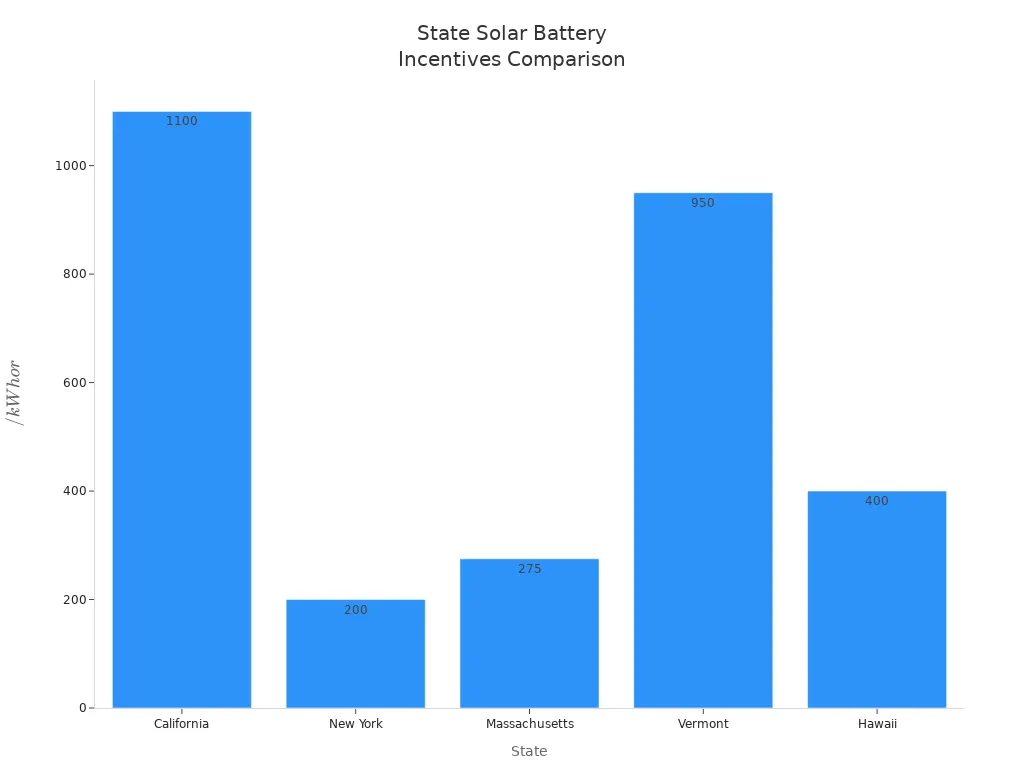
You can save money with incentives and rebates. Many states have programs that give you money back when you install a solar battery. The federal government gives tax credits too. The chart below shows some top incentives by state:
Type of Incentive | Impact on Cost and ROI |
|---|---|
Government Tax Credits | Lower upfront cost, improve ROI, shorten payback period |
State-Level Rebates | Give you savings right away, make the investment better |
Performance-Based Incentives | Pay you for energy stored or used during busy times, increase your savings |
The Inflation Reduction Act gives you a tax credit for battery storage. Some states, like California and New York, give extra rebates. These programs can save you thousands of dollars.
Solar Battery Economics depends on how much you save on your energy bill. Time-of-use rates charge more during busy hours. If you use your battery then, you avoid high prices. Net metering lets you store extra solar energy and use it later. With a battery, you use your own solar power when electricity costs the most. This helps you save more every month.
The BEINENG Home ESS has a smart app. You can track your savings and control your energy use. You save the most when you match your battery use to your utility’s pricing plan.

Before you start, you need to collect some key numbers. These numbers help you see if your solar battery is a good deal. The table below shows what to gather and why it matters:
Factor | Impact on Payback Period | Notes |
|---|---|---|
Initial System Cost | Higher cost = Longer payback | Includes equipment, installation, and permits. |
Electricity Rates | Higher rates = Shorter payback | Varies by region and utility. |
System Size & Efficiency | Larger/More efficient = Shorter payback | Matches energy production to household needs. |
Available Incentives | More incentives = Shorter payback | Federal tax credits, state rebates, local programs. |
Energy Consumption | Higher consumption = Shorter payback | More electricity offset by solar means greater savings. |
You should also know how much you save on your energy bill each year. Remember to include any costs for keeping your system working. These numbers help you understand your Solar Battery Economics.
You can figure out your payback period and ROI in a few steps. Here’s how you do it:
Find your net installation cost. Take away any tax credits or rebates from your total cost.
Estimate your yearly energy bill savings. Check your old bills to see how much you will save.
Calculate your payback period. Divide your net installation cost by your yearly savings.
Figure out your net profit. Subtract your total costs from your total savings over the system’s life.
Calculate your ROI. Use this formula:
ROI = (Total Net Profit / Net Installation Costs) x 100
Tip: The payback period formula is:
Payback Period = Initial Investment Cost / (Annual Savings + Buyback Plan Benefits - Annual Maintenance Costs)
These steps help you see how long it takes to get your money back and how much you can earn.
Let’s look at an example. You buy a solar battery system for $28,000. You get a 30% federal tax credit, so you save $8,400. Your net installation cost is $19,600. Your system covers your whole yearly utility bill of $1,800.
Net Installation Cost: $28,000 - $8,400 = $19,600
Annual Savings: $1,800
Payback Period: $19,600 ÷ $1,800 ≈ 10.9 years
After about 11 years, you start making real profits. If your system lasts 20 years, you save $36,000 in total. Your net profit is $36,000 - $19,600 = $16,400. Your ROI is ($16,400 ÷ $19,600) x 100 ≈ 83.7%.
You can make these calculations easier with the myBeineng app. The app tracks your energy use and savings as they happen. Here’s what you can check:
Metric | Description |
|---|---|
Energy Production | See how much energy your solar panels make. |
Energy Consumption | Track how much electricity your home uses and when you use the most. |
Grid Interaction | Watch how much energy you send to or get from the grid. |
Self-Consumption Rate | Measure how much solar energy you use right away at home. |
Financial Savings | View your savings on your utility bills in dollars. |
Battery State of Charge | Check how much energy your battery has and uses. |
Performance Ratio | See how well your system works compared to its best possible performance. |
Real-Time Insights | Get tips to change your energy use and save more. |
Anomaly Detection | Find problems early, like dirty panels or inverter trouble. |
With these tools, you can keep your system working well and save more money. You get a clear look at your Solar Battery Economics and can make smart choices for your home.
You get more value when your solar battery system fits your needs. First, check how much energy you use every day. Look at your energy bills to find this number. A good system stores extra solar energy for later. This means you have power when you need it most. You save money and use the grid less.
Here are some smart ways to size your system:
Best Practice | Description |
|---|---|
Factor in overall costs | Think about all costs, like installation and maintenance. |
Load shifting | Save extra solar energy for busy times. |
Backup for essential systems | Make sure your battery powers important things during outages. |
Whole-home backup | Get a battery big enough for your whole house if you want full backup. |
Calculate battery needs | Use your energy numbers to pick how many batteries you need. |
Use sizing formula | Battery storage capacity = (Total Daily Energy Consumption) / (DoD × Days of Autonomy) |
A modular system, like BEINENG Home ESS, is flexible. You can start with a small system. Add more battery modules if you need them later. This design saves money and gets your system ready for the future.
Tip: Keep your system working well with regular checks. Use big appliances during the day to save even more.
Solar batteries last about 10 to 12 years. Solar panels last much longer, up to 40 years. You may need to replace batteries more than once. Planning for this helps you know your long-term costs.
Here is a table that shows battery types and how long they last:
Battery Type | Lifespan | Cycles |
|---|---|---|
Lithium-Ion (LiFePO4) | 15-20 years | 6,000 cycles |
Lithium-Ion (NMC) | 10-15 years | 4,000 cycles |
Flooded Lead-Acid | 3-7 years | 500-1,200 cycles |
Sealed Lead-Acid (AGM/Gel) | 4-8 years | 600-1,500 cycles |
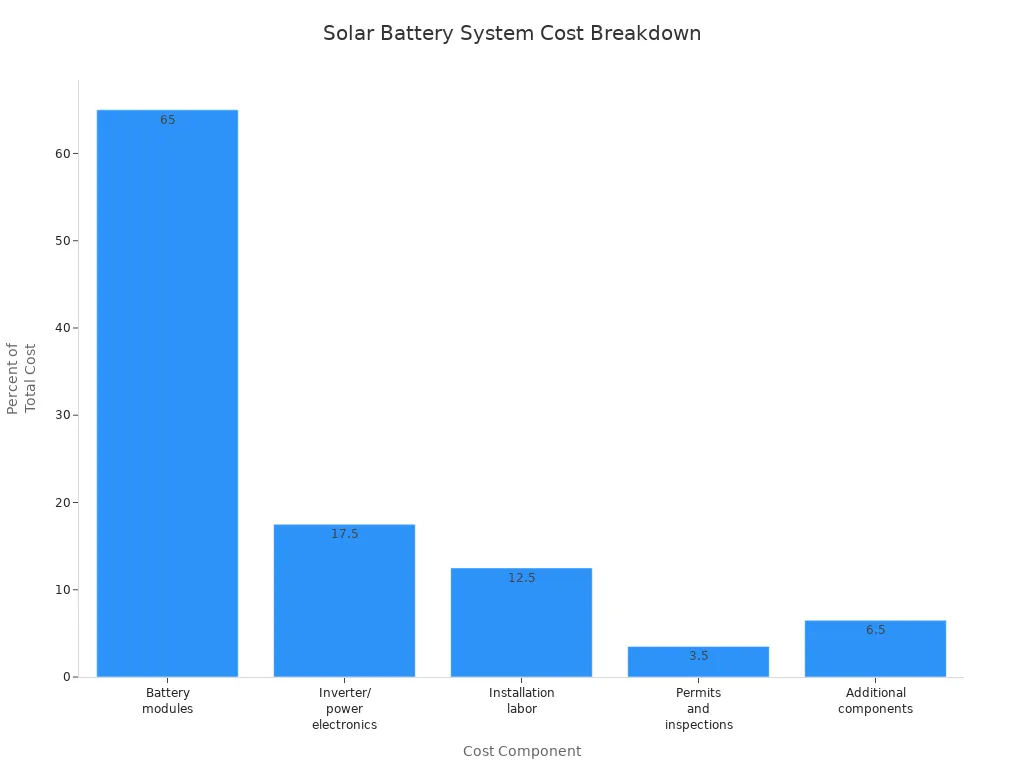
Battery modules cost the most in your system. BEINENG Home ESS uses stackable modules. You can mix new and old batteries. This makes replacement easier and lowers your total cost. Smart management systems help you do less maintenance and keep your system running well.
You can save more money with state and federal incentives. These programs lower your first costs and help you pay back faster. Each state has different rebates and credits.
State | Incentive | Details |
|---|---|---|
California | Self-Generation Incentive Program | Money per kilowatt rebate, extra help for high fire risk and low-income homes. |
Connecticut | Energy Storage Solutions | Up to $16,000 for installation, 50% savings for businesses. |
Massachusetts | Mass Save Connected Solutions | Money and loans to lower battery costs and help the grid. |
New York | Long Island Energy Storage Incentive | $250 per kilowatt rebate, but funds are running out. |
Note: Incentives can change or end. If you act soon, you get the best savings. BEINENG Home ESS’s flexible design lets you change your system as programs change. This keeps your Solar Battery Economics strong for many years.
A solar battery system helps you save money. It gives you more control over your energy. It keeps your home safe when the power goes out. You get the most benefits if your electricity costs are high. You also benefit if you pay more at certain times or lose power often.
Look at how much energy you use each day. Pick a battery size that fits your needs.
Try solar calculators to see how your roof and weather change your savings. Local electricity prices matter too.
Do not buy a battery that is too big. Make sure you choose a good installer.
You can make a smart choice by using your own numbers. Know what you need before you buy.
You should check your energy use, local electricity rates, and available incentives. If you want backup power or lower bills, a solar battery can help. Use a calculator or talk to an installer for a custom answer.
Electricity rates, system size, and incentives have the biggest impact.
High rates and good incentives shorten your payback period. A well-sized system matches your needs and saves you more.
Yes, you can. The BEINENG Home ESS uses stackable battery modules. You start small and add more as your needs grow. This gives you flexibility and saves money.
The app tracks your energy use and savings in real time. You see when to use stored energy for the best savings. You also get tips to improve your system’s performance.


Compact, quiet, and powerful, it keeps your essentials running during outages and lets you charge anywhere with solar power or grid power.
Perfect for renters who need flexibility without compromise.
Our estimator is only set up to provide preliminary estimates and installer information to residents of single family homes.