
 Email Us
 Contact us
 Whats App
Single family home


You use networks every day and need them to work well. Backup power helps telecom systems keep working if the main power goes out. When the power fails, services stop, and customers get upset. This can cause big problems. Studies show that 43% of outages happen because of power problems. Almost 30% of big outages lasted more than one day in 2021. Telecom operators want better Power Storage Solutions to stay strong. New battery systems, like lithium-ion and the BEINENG PowerPack, give quiet and flexible backup power for important places.
Evidence Description | Statistic |
|---|---|
Percentage of outages caused by power-related issues | 43% |
Major outages lasting more than 24 hours in 2021 | Nearly 30% |
Serious or severe outages reported in 2021 | 27 out of 108 |
Backup power is very important for telecom networks. It helps keep service on during power outages. Pick systems that turn on right away to keep customers satisfied.
Modern lithium-ion batteries, like the BEINENG PowerPack, last longer and need less care. They work well for city and country telecom sites.
Hybrid power systems use batteries, solar, and generators together. These systems can lower costs and help the environment. They also need fewer maintenance checks.
It is important to check and take care of battery systems often. Look for rust and loose wires to keep them working well and lasting longer.
Learn about new technology and rules for power storage. New ideas can make your telecom network better and more earth-friendly.
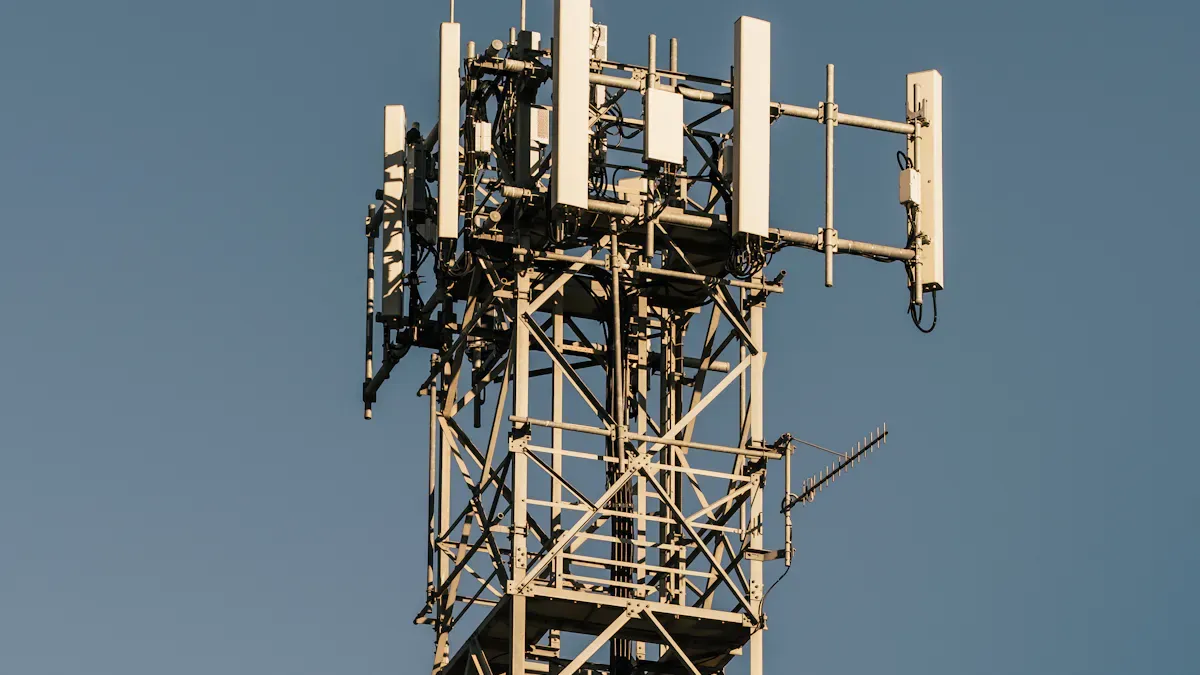
You use telecom networks for calls, texts, and internet. These networks must work even if the power goes out. Power Storage Solutions help keep networks running during outages. Telecom operators need backup systems that turn on right away and give steady power. In cities, storms or grid problems can cause many outages. In rural places, outages can last longer and repair crews take more time to arrive. Both city and rural areas need strong backup power.
Telecom battery backup systems help your network stay online and keep service good. They also help you keep customers happy. Outages can make your business lose a lot of money. You need backup systems that switch on fast, keep voltage steady, and last long enough for big outages. The table below shows what telecom backup power needs:
Requirement | Description |
|---|---|
Instant failover during outages | Ensures immediate power supply to prevent service interruptions. |
Stable voltage supply | Maintains consistent voltage for sensitive telecom equipment. |
Sufficient runtime | Provides power for 4 to 48 hours or more, especially critical in rural areas. |
You can pick from different backup batteries. VRLA batteries cost less but do not last as long and need more care. Lithium-ion batteries last longer, work better in tough weather, and save money over time. Solar-powered microgrids are good for places without grid power and help you use less diesel.
VRLA Batteries: Low cost, but shorter lifespan and maintenance required.
Lithium-Ion Batteries: Higher cycle life, better performance in harsh climates, and lower total cost of ownership over time.
Solar-Powered Microgrids: Ideal for off-grid sites, reducing reliance on diesel and enhancing sustainability.
New products like the BEINENG PowerPack are small, quiet, and easy to add more if needed. You can stack battery packs to fit your site. You can charge them with solar or grid power. This makes it easy to keep your network strong anywhere.
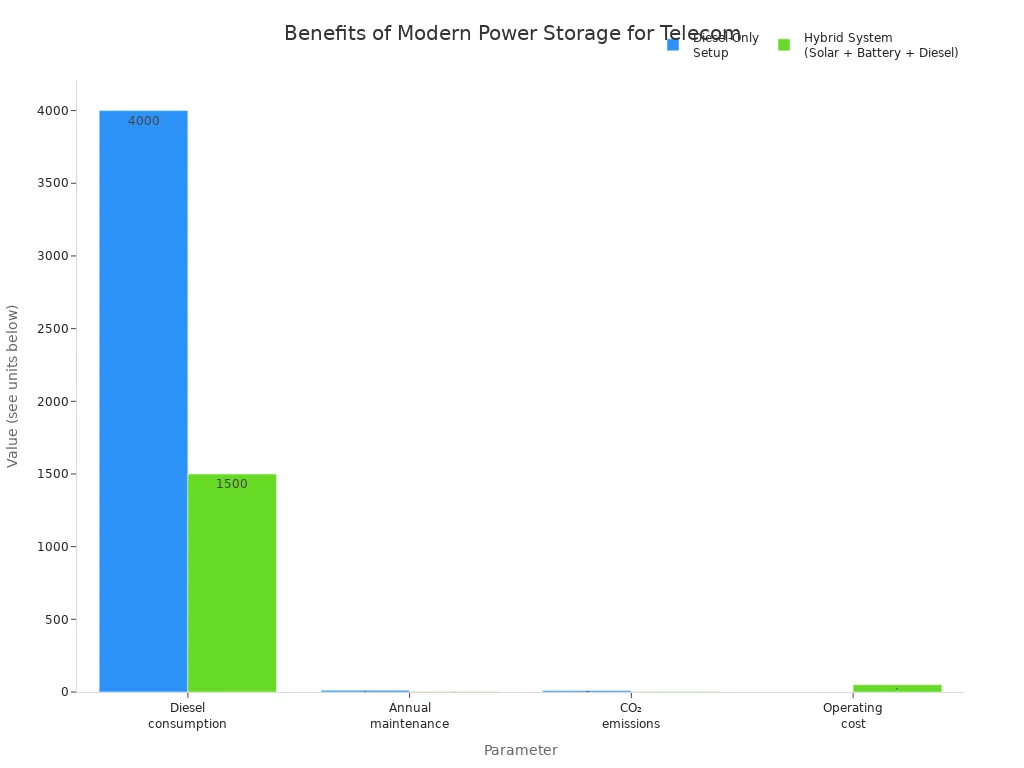
You get many good things when you use new Power Storage Solutions. Modern systems help you save money, need less fixing, and make less pollution. Hybrid setups use batteries, solar panels, and diesel generators together. These setups use less diesel and need fewer repair visits. The table below shows how diesel-only and hybrid systems compare:
Parameter | Diesel-Only Setup | Hybrid System (Solar + Battery + Diesel) |
|---|---|---|
Diesel consumption | ~4,000 L/year | ~1,500 L/year |
Annual maintenance visits | 12 | 4 |
CO₂ emissions | 10.6 tons | 3.8 tons |
Operating cost reduction | — | 40–60% |
You can watch and control these systems in real time with Energy Management Systems (EMS). EMS helps you find problems early and keep batteries charged. You make your network more reliable and keep it working longer. As 5G grows, you will see more AI and IoT in power systems. These tools help you keep your network working during storms or grid problems.
Modern lithium-ion batteries, like the ones in the BEINENG PowerPack, work well and are easy to add more. You can add more batteries as your network gets bigger. You can charge them with solar power, which saves money and helps the planet. These batteries are quiet and easy to install. You can use them in cities, rural places, or far-away sites.
Tip: Pick Power Storage Solutions that fit your site. Look for systems with instant failover, steady voltage, and enough runtime. Products like BEINENG PowerPack give you strong and easy-to-grow backup power.
You make your network stronger when you use new Power Storage Solutions. You protect your customers and your business from outages. You also get ready for new growth and new technology.
You can find lead-acid and lithium-ion batteries in backup systems. Lead-acid batteries have been used for many years. They are cheaper at first, but they do not last as long. Lithium-ion batteries last much longer and work better in bad weather. The table below shows how long each battery type lasts:
Battery Type | Average Lifespan (Cycles) |
|---|---|
Lead-Acid | 300 - 550 |
Lithium-Ion | > 5,000 |
Lead-acid batteries need more care. You have to check the liquid inside and look for rust. This means you pay more for workers and repairs. Lithium-ion batteries use smart systems to watch how they work, so you do not need to check them as much.
Lead-acid batteries need more care, which costs more money.
You have to refill the liquid and check for rust in lead-acid batteries.
Lithium-ion batteries need less care because they have smart monitoring.
Lithium-ion batteries give you more energy in a smaller and lighter size. They charge faster and last longer. This makes them a good choice for many telecom sites.
You might hear about flow batteries as a new backup power choice. These batteries keep energy in a liquid. They are good for long backup times and big energy needs. More companies use flow batteries as they add solar or wind power and build more towers. Flow batteries help balance energy when using solar or wind. They last a long time and work well in hard places.
More money in solar and wind power makes people want flow batteries.
Data centers and towers need more energy storage, so demand goes up.
Flow batteries store energy for a long time, which helps many sites.
Utilities use flow batteries to keep energy balanced.
Strong and long-lasting batteries help telecom and utility companies.
You want to choose the best battery for your site. Each battery type has good and bad points. The table below shows the main features:
Feature | Lead-Acid Batteries | Lithium Batteries |
|---|---|---|
Energy Density | Lower energy density | Higher energy density (2–3 times lead-acid) |
Lifespan | Shorter cycle life (500–1500 cycles) | Longer lifespan (3000–5000 cycles or more) |
Weight | Heavier and bulkier | Lighter and easier to deploy |
Maintenance Needs | More frequent maintenance | Reduced maintenance needs |
Charging Speed | Slower charging | Faster charging (up to 80% in 1–2 hours) |
Total Ownership Cost | Higher total ownership cost | Lower total ownership cost |
Environmental Adaptability | Less adaptable to extreme conditions | Performs better in hot and cold climates |
You can also look at the main good and bad points for each battery:
Battery Type | Strengths | Weaknesses |
|---|---|---|
Lithium-Ion | High energy, lasts long, does not lose charge fast | Costs more, can be sensitive to heat or cold |
Nickel-Metal Hydride | Costs less, better for the environment | Less energy, does not last as long |
Lead-Acid | Cheaper, gives high power quickly | Heavy, does not last as long |
Many telecom operators now pick lithium-ion batteries for Power Storage Solutions. Products like BEINENG PowerPack use advanced lithium technology. You get backup power that is reliable, easy to grow, and works well for your network.
Telecom networks must work all the time, even in storms. Modern battery systems give you backup power when the main power fails. This keeps your calls and data working. These systems use advanced batteries and hybrid supercapacitors. They can last more than 20 years and work for over 20,000 cycles. In emergencies, these systems help you respond faster. Response times can be up to 83% better during hurricanes. New battery systems also help diesel generators use less fuel and work better. These features help your network stay strong:
Feature | Benefit |
|---|---|
Keeps communication running during outages | |
Long Lifespan | Hybrid supercapacitors last over 20 years |
Fast Emergency Response | 83% improvement in disaster response times |
Generator Efficiency | Doubles performance, reduces fuel use |
Tip: Reliable backup power means fewer dropped calls and happier customers.
Backup systems should save energy and be safe. Lithium-ion batteries store a lot of energy and last a long time. They do not need much care and work well. Safety is important, so you should pick systems with top certifications. These include UL 9540, UL 9540A, and UL 1973. These certifications show your backup power is safe and follows strict rules.
Battery Type | Energy Density (Wh/kg) | Cycle Life (cycles) | Efficiency | Maintenance |
|---|---|---|---|---|
Lithium-Ion | Up to 250 | Up to 3,000 | High | Low |
VRLA | 20–40 | <350 | Moderate | Moderate |
NiCd | 40–60 | 2,000 | Moderate | High |
Certification | Purpose and Relevance |
|---|---|
UL 9540 | Ensures system safety, performance, and construction |
UL 9540A | Tests for fire safety and thermal runaway |
UL 1973 | Certifies battery modules for electrical and environmental safety |
UL 1741 | Validates safe grid connection for hybrid and renewable systems |
UL 1974 | Certifies safe reuse of batteries, supporting sustainability |
Networks grow fast, so backup power must grow too. Modular battery systems let you add more power as you need it. You can use smart grids, IoT, and AI to watch your batteries. These tools help you find problems before they cause outages. Hybrid setups use solar, batteries, and generators together. This keeps your network working anywhere.
Modular designs let you add or upgrade without changing everything.
Smart monitoring with IoT sensors helps you find problems early and save energy.
Hybrid systems use solar, batteries, and generators for strong backup.
Feature | Description |
|---|---|
Intelligent Load Management | Adjusts to changing needs, saving energy and money |
High Reliability | Redundant design and hot-swapping keep downtime low |
Scalable Capacity | Add power as needed, lowering total cost by up to 25% |
Compact Design | Fits into small spaces, easy to deploy |
Green Network Support | Works with solar and renewables for a cleaner network |
Note: Flexible systems can help you save up to 30% on costs and cut maintenance by up to 40%. You can keep your network strong and ready for new changes.
You must check your site before you install any power storage system. Find out how much power your telecom site uses every day and during busy times. Measure the space you have for batteries and other equipment. Look at the weather in your area because temperature and humidity can change battery life. Pick a system that fits your power needs and your site. Modular systems, like BEINENG PowerPack, let you add more batteries as your network gets bigger. You can use BEINENG’s system estimators to help you choose the right backup power size.
Tip: Get help from vendors and use online tools to make sure your system fits your site now and later.
Regular checks help your backup power stay reliable. You should look at batteries for rust, loose wires, or damage. Clean battery terminals with a soft cloth so connections stay strong. Watch the temperature and humidity in your battery room. Follow charging rules so you do not overcharge or undercharge. Keep battery charge between 20% and 80% for best results.
Routine Check | Description |
|---|---|
Inspections | Check batteries often for rust, loose wires, and damage. |
Cleaning | Clean battery terminals with a soft cloth to keep them working well. |
Environmental Monitoring | Keep temperature between 20°C and 25°C; watch humidity and air flow. |
Charging Protocols | Follow charging rules to stop overcharging or undercharging. |
Discharging Practices | Keep battery charge between 20% and 80% for best performance. |
Remote monitoring helps you find problems early. You can check voltage and battery health from anywhere. This technology finds power issues before they cause outages, checks the environment, and helps you fix problems faster. You can also use predictive maintenance to plan repairs when things are quiet.
Find power problems early
Watch environmental conditions
Fix things faster
Plan repairs ahead of time
Use automation for local control
Lithium-ion batteries last much longer than lead-acid batteries. You can get 3,000 to 5,000 cycles or more with little maintenance. The table below shows the difference:
Battery Type | Cycle Life (Cycles) | Maintenance Requirements |
|---|---|---|
Lithium-ion | 3,000–5,000+ | Low |
Lead-Acid | <350 | Moderate |
Battery Management Systems (BMS) help batteries last longer. They keep each cell safe and balanced. You should track battery health, write down replacement dates, and plan to swap batteries at different times to avoid downtime. Match battery swaps with routine checks to keep your network working well.
Check how long batteries last (usually 3–5 years)
Watch battery health with voltage and temperature checks
Plan to swap batteries at different times
Write down installation and replacement dates
Work with maintenance teams
Note: Using BEINENG’s support center gives you updates, troubleshooting, and expert help for your power storage system.
When you pick advanced battery systems for telecom backup, you have to think about many costs. First, you pay for the batteries and to put them in. You also pay for maintenance over time. How much energy you use and what you pay for electricity can change your total costs. Sometimes, the government gives you money back or discounts to help with costs. Battery prices can go up or down because of the market. You should look at all the costs together and check the average cost for storing energy to see which system is best.
Cost Factor | Description |
|---|---|
Upfront investment | Initial costs required to purchase and install the battery systems. |
Maintenance costs | Ongoing expenses related to the upkeep of the battery systems. |
Energy usage patterns | Variability in energy consumption that affects overall costs. |
Electricity prices | Fluctuations in energy costs that impact operational expenses. |
Government incentives | Financial support or rebates that can reduce overall costs. |
Market conditions | Economic factors that influence battery pricing and availability. |
Total Cost of Ownership | Comprehensive assessment of all costs associated with battery systems. |
Levelized Cost of Storage | Average cost per unit of energy stored, useful for comparing technologies. |
To figure out return on investment (ROI), you add up what you spend at first, what you keep spending, and any money you make. You might make money by renting out equipment or charging more for green technology. If you spend less on fixing and powering your system, you get your money back faster.
First costs include buying equipment, shipping, and changing your site.
You keep paying for things like repairs, insurance, and storage.
You can earn money from renting, using, or charging for services.
You help the planet when you recycle batteries and follow new rules. Many telecom operators now recycle lithium-ion batteries. In 2019, people recycled 58% of used lithium-ion batteries around the world. Recycling means less trash and saves important materials. You also have to follow rules like the EU Battery Directive and the US Resource Conservation and Recovery Act. These rules tell you how much to recycle and what chemicals you cannot use.
Regulation | Description |
|---|---|
EU Battery Directive 2006/66/EC | Sets rules for battery recycling and limits hazardous substances. |
Resource Conservation and Recovery Act (US) | Regulates battery systems and requires safe disposal. |
EU's proposed Battery Regulation | Adds carbon footprint rules and supply chain checks. |
New laws want companies to be greener and reuse more materials. You will see more rules about using recycled parts and saving key materials.
New technology in power storage helps you a lot. 5G networks need more power, so you need better batteries. Smart Battery Management Systems (BMS) let you watch and protect your batteries. Artificial Intelligence (AI) and Internet of Things (IoT) tools help you see energy use right away. AI can lower energy use by up to 30% by turning off parts of the network when not needed. Making batteries closer to where you use them makes delivery faster and costs less. New battery types and better ways to make them also help the planet and keep your system strong.
5G networks need bigger and better batteries.
Smart BMS and IoT let you check batteries and fix problems before they get big.
AI helps you use less energy and save money.
Making batteries nearby means you get them faster and pay less for shipping.
Green battery designs are better for the environment.
Tip: Keep learning about new trends and rules so your telecom network stays strong, saves money, and is good for the planet.
You need backup power that works well to keep your telecom network strong. Pick storage solutions that are right for your site and what you need. Lithium-ion systems, such as the BEINENG PowerPack, give you backup that is flexible and works well. You can add more batteries as your network gets bigger.
Tip: Keep learning about new battery technology. New ideas will help you keep your network working and protect your service later.
You get longer life, faster charging, and less maintenance with lithium-ion batteries. These batteries work well in hot or cold weather. You can also add more batteries as your network grows.
You should check your site’s daily and peak power use. Use tools like BEINENG’s system estimator. This helps you pick the right battery size for your needs.
Yes, you can. Many modern systems, like BEINENG PowerPack, let you charge batteries with solar panels. This helps you save money and lower your carbon footprint.
You should check your system every month. Look for rust, loose wires, or damage. Use remote monitoring to track battery health and fix problems early.


Compact, quiet, and powerful, it keeps your essentials running during outages and lets you charge anywhere with solar power or grid power.
Perfect for renters who need flexibility without compromise.
Our estimator is only set up to provide preliminary estimates and installer information to residents of single family homes.