
 Email Us
 Contact us
 Whats App
Single family home

The right home battery capacity depends less on the size of the house than on how much electricity the household actually needs, when that electricity is used, and what the battery is expected to do. A home that uses 15 kWh per day may not need a 15 kWh battery, while another home with the same daily consumption could benefit from a larger battery because most of its demand occurs after sunset or during outages.
For most residential projects, battery sizing comes down to four questions: how much energy the home uses, how much of that energy needs to come from the battery, how long backup should last, and how much solar energy is available to recharge it. The rated battery capacity is only part of the calculation because usable capacity, inverter efficiency, reserve settings, and discharge limits also affect the energy available to the home.
There is no single battery size that works for every household. A small home with modest evening consumption may work well with 5–10 kWh, while a larger home with air conditioning, electric cooking, or extended backup requirements may need 15–20 kWh or more.
A useful starting point is to look at the household's daily electricity consumption and evening load, rather than choosing a battery simply because a particular capacity is popular.
Household requirement | Typical starting range | More suitable for |
Basic backup | 5–10 kWh | Refrigerator, lights, Wi-Fi and essential outlets |
Daily solar shifting | 10–15 kWh | Storing daytime solar for evening use |
Higher evening consumption | 15–20 kWh | Larger households and heavier residential loads |
Extended whole-house backup | 20 kWh+ | Larger loads or longer outage coverage |
These ranges are for initial planning rather than fixed recommendations. The actual requirement can change substantially depending on the home's load profile.
For example, a household may consume 20 kWh over an entire day but use only 6–8 kWh between sunset and bedtime. Installing a 20 kWh battery would not automatically make sense. A smaller battery may cover the useful portion of the solar-shifting cycle while costing less and reaching a higher utilization rate.
The opposite can also happen. A home with relatively moderate daily consumption may still need a larger battery if the homeowner wants overnight backup or wants critical appliances to operate through a long outage.
The first step in determining battery capacity for home use is to find out how much electricity the property actually consumes.
Monthly electricity bills provide a useful starting point. If a household uses 600 kWh in a 30-day month, its average daily consumption is approximately 20 kWh. But that number should not be treated as the required battery size.
The battery does not necessarily need to supply all 20 kWh.
Some electricity is consumed directly during the day. Some comes from the grid. Some may be supplied directly by the solar array. The battery mainly handles the portion of energy that needs to be shifted from one time of day to another or reserved for backup.
A home that consumes most of its electricity between 10 a.m. and 3 p.m. has a different storage requirement from a home where most demand occurs between 6 p.m. and midnight.
This distinction becomes particularly important in solar-plus-storage installations.
Suppose a household consumes 20 kWh per day:
· 8 kWh is used directly during daylight hours.
· 7 kWh is used in the evening.
· 3 kWh is used overnight.
· 2 kWh is consumed by flexible or occasional loads.
The battery does not necessarily need to provide 20 kWh. If solar energy can directly cover the daytime demand, the storage system may primarily need to handle the 7 kWh evening load, overnight consumption, and a reasonable reserve.
That can make a 10–15 kWh home battery storage system more practical than simply matching the battery to total daily consumption.
One of the most common sizing mistakes is treating daily energy storage and emergency backup as the same requirement.
They are related, but the calculation is different.
If the main purpose is to store excess solar energy during the day and use it after sunset, the important numbers are:
solar surplus + evening consumption + battery usable capacity
For example, if the solar system regularly produces 8 kWh more electricity than the house needs during the day, but the household uses 7 kWh after sunset, a battery in the 10 kWh range may already provide a useful amount of storage.
A much larger battery would only be worthwhile if there is enough excess solar energy to charge it regularly or if the homeowner has another reason to maintain the additional capacity.
Backup sizing starts with the loads that must remain operational.
A homeowner may not need to power every appliance during an outage. Refrigeration, lighting, internet equipment, security systems, selected outlets, and certain essential equipment may be the priority.
For example:
Essential load | Estimated average power |
Refrigerator | 150 W |
Wi-Fi and networking | 30 W |
Lighting | 100 W |
Television | 100 W |
Small appliances and other loads | 120 W |
Estimated total | 500 W |
If those loads average 500 W and need to operate for eight hours:
0.5 kW × 8 hours = 4 kWh
The battery would then need more than 4 kWh of usable energy once reserve and conversion losses are considered.
This is why a household may not need a huge battery for basic emergency backup even when its total daily electricity consumption is relatively high.
For a homeowner looking at a 51.2V home battery, the same principle applies. Voltage and capacity describe different parts of the system, so the battery should be evaluated together with the inverter, output power, BMS and intended loads rather than by kWh alone. A detailed look at voltage, capacity and residential backup requirements is available in the guide to 51.2V home battery systems.
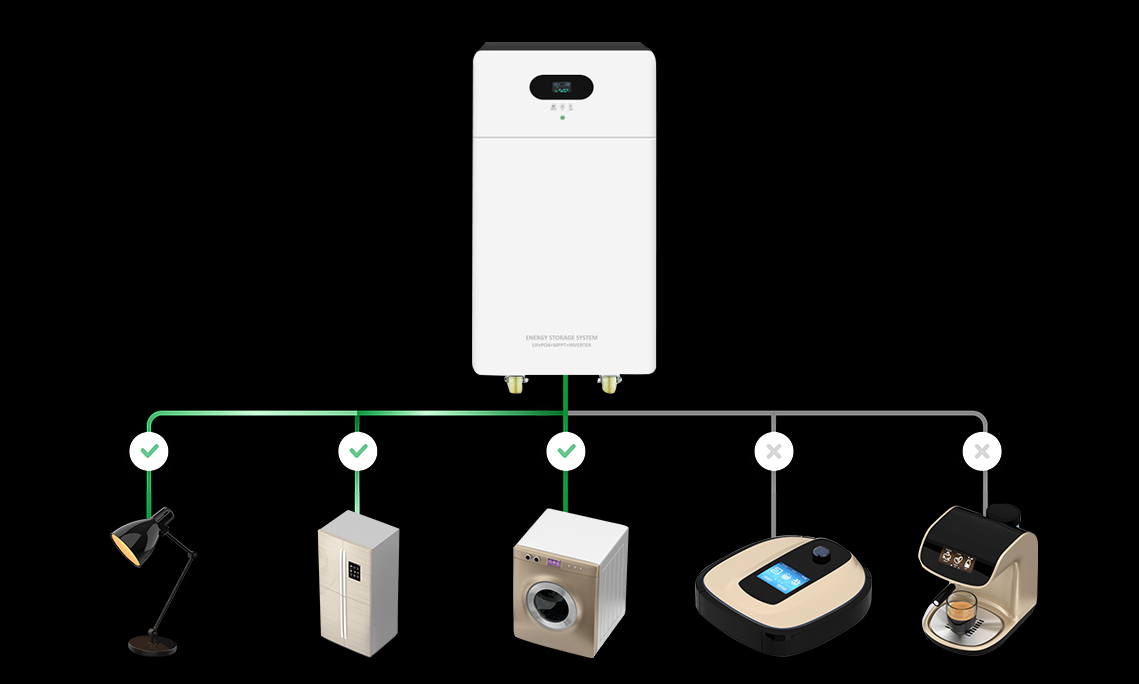
A practical sizing process does not need complicated software at the first stage. The basic calculation can be done from electricity bills, smart-meter data and a list of essential loads.
Take the household's monthly electricity use and divide it by the number of days in the billing period.
For example:
600 kWh ÷ 30 days = 20 kWh/day
This gives the household's overall energy demand.
It does not tell you the battery size yet.
Next, determine how much electricity is used after solar production falls.
This is often the most important number for a solar battery because it represents energy that could otherwise come from the grid.
Smart-meter data is particularly useful here because it can reveal whether the home consistently uses 5 kWh, 8 kWh or 12 kWh after sunset.
For outage planning, create a separate load list.
Do not automatically include every appliance.
A homeowner may choose to keep:
· Refrigeration and lighting
· Internet, security and communication equipment
· Selected household outlets
· Essential heating or cooling equipment
The required battery size changes significantly when high-power appliances such as electric water heaters, ovens, pool pumps or central air conditioning are included.
Backup requirements should be expressed in hours rather than simply saying "whole-house backup."
A four-hour requirement is very different from an overnight requirement.
For example, if essential loads average 800 W:
0.8 kW × 10 hours = 8 kWh
That 8 kWh is the theoretical energy requirement before accounting for usable capacity, inverter losses and reserve.
The final battery should not be selected using the nominal capacity alone.
If a battery is advertised as 15 kWh, the actual energy available to the home depends on the manufacturer's operating limits, reserve settings, BMS strategy and inverter efficiency.
That difference becomes increasingly important when comparing products from different manufacturers.
Battery specifications often place the largest number near the top of the product sheet: 10 kWh, 15 kWh, 20 kWh and so on.
That number is useful, but it does not tell the whole story.
A buyer should distinguish between nominal capacity and usable capacity.
Specification | What it tells the buyer |
Nominal capacity | Total rated energy of the battery |
Usable capacity | Energy available within the specified operating range |
Depth of discharge | How much of the battery can normally be discharged |
Reserve capacity | Energy intentionally retained for protection or backup |
Inverter efficiency | Energy lost when converting DC battery power to AC |
For procurement, usable capacity is often the more meaningful comparison.
Two batteries with the same nominal capacity can deliver different amounts of usable energy depending on their operating settings and system architecture.
This is also why battery capacity should be considered alongside continuous output power. A battery may have enough stored energy in kWh but still be unsuitable for a household if its inverter cannot handle the required load.
The most common residential battery sizes are easier to understand when they are connected to actual use cases.
A 5 kWh battery can make sense for a smaller energy system or a household focused on basic backup.
It may cover several essential loads for a limited period, but it can become restrictive if the homeowner wants to run air conditioning, cooking equipment or multiple high-power appliances.
It is often better suited to targeted backup rather than unrestricted whole-house operation.
Around 10 kWh provides a useful middle ground for many homes.
It can support evening solar consumption and provide meaningful backup without requiring the space and investment associated with a much larger battery bank.
For a household that uses roughly 6–10 kWh after sunset, this size can be particularly practical.
A 15 kWh battery becomes more useful when the household has higher evening demand or wants more flexibility during outages.
It can provide enough usable energy for a substantial overnight load while leaving room for reserve and operating losses.
The suitability of 15kWh battery storage still depends on the solar system's ability to recharge the battery and the household's actual energy consumption. A 15 kWh battery is not automatically the right answer simply because it offers more stored energy.
For homeowners comparing different residential configurations, a 15kWh home battery can be considered when the project requires higher storage capacity and longer backup coverage.
Larger battery systems are generally justified when the household has one or more of the following:
· High daily electricity consumption
· Significant evening loads
· Frequent or lengthy outages
· Large solar generation that would otherwise be curtailed
· A requirement to keep more household circuits operational
A larger battery should have enough charging opportunity and energy demand to justify its cost.
Oversizing is a real issue in residential storage projects.
If a battery is much larger than the household's normal energy requirement, it may spend a significant amount of time partially charged. If the solar array cannot provide enough excess energy to refill the battery regularly, the additional capacity may provide little practical value.
The extra capacity can also increase:
· Initial equipment cost
· Installation requirements
· Floor or wall space
· System complexity
· Payback period
A useful rule for early-stage planning is simple:
The battery should be large enough to cover the intended load, but not so large that normal operation rarely uses its available capacity.
The final choice should balance energy demand, solar production, backup expectations and future expansion.
Battery capacity should not be selected independently from the solar array.
Imagine two homes with identical 15 kWh batteries.
The first home has enough solar generation to produce 12 kWh of surplus energy on a typical day. The second produces only 4 kWh of surplus energy.
The batteries are the same size, but their practical utilization will be very different.
The first system has enough excess solar to charge a substantial portion of the battery during the day. The second may rarely charge beyond a small fraction of its capacity unless grid charging is used.
A practical solar-plus-storage system therefore considers the relationship between:
Solar generation → daytime household load → excess solar → battery charging → evening demand
This is one reason battery sizing should be completed after reviewing actual solar production data where possible.
An undersized battery may still work, but the homeowner will encounter clear limitations.
For daily solar storage, the battery may reach full charge early in the afternoon and leave additional solar energy unused.
During the evening, the battery may then reach its minimum state of charge before the household's demand has finished.
During an outage, a small battery may require aggressive load management to keep essential appliances running.
The problem is not simply "not enough kWh." The battery may also lack sufficient output power for large loads.
For example, a home may have a 10 kWh battery but a 5 kW inverter. The stored energy may be adequate for several hours, but running multiple high-power appliances simultaneously could still exceed the inverter's continuous output limit.
Oversizing creates a different problem.
A large battery provides more reserve, but it needs a realistic way to be charged and used.
If a household's normal evening consumption is only 5 kWh and its solar system rarely produces more than 6 kWh of daily surplus, a 20 kWh battery may spend much of its operating life underutilized.
The better approach is to ask:
How much of the battery will actually be used on a normal day, and how much additional capacity is needed specifically for backup?
That distinction produces a much more realistic sizing decision.
Consider a household with the following profile:
· Average daily consumption: 18 kWh
· Daytime direct solar consumption: 7 kWh
· Evening and overnight consumption: 9 kWh
· Essential backup load: 1 kW
· Desired backup duration: 8 hours
For normal backup:
1 kW × 8 hours = 8 kWh
That means the system needs approximately 8 kWh of usable energy for the selected backup loads before accounting for reserve and conversion losses.
For daily solar shifting, however, the household may want to store a larger amount because approximately 9 kWh is consumed after sunset.
A 10 kWh system may work for basic daily shifting and backup, while a 15 kWh system provides more operating margin for higher evening consumption, reserve energy and longer outages.
The correct choice would still depend on the actual usable capacity, inverter rating and solar production.
This is also where modular systems can become useful. A homeowner who expects electricity demand to increase later may prefer a system that allows additional battery modules rather than purchasing the maximum capacity on day one.
A residential energy storage system has several specifications that need to work together.
Measured in kWh, capacity determines how much energy the battery can store.
Measured in kW, power determines how much energy the system can deliver at one time.
The system voltage affects current, inverter compatibility and overall electrical architecture. Many residential systems use a 51.2V nominal battery architecture because it aligns with common LiFePO4 configurations and residential energy-storage designs.
The battery management system monitors cell voltage, temperature, current and other operating conditions. Communication between the battery BMS and inverter is also important for coordinated charging, discharging and protection.
If future household demand is uncertain, a modular system may offer more flexibility than installing a very large battery from the beginning.
For buyers comparing an all-in-one energy storage system, these factors should be checked alongside the stated kWh capacity.
A supplier quotation should contain more than a battery capacity number.
Before placing an order, check the following:
· Nominal vs usable capacity — Make sure the quoted kWh figure is clearly defined.
· Continuous and peak output — Confirm that the inverter can handle the home's intended loads.
· Inverter compatibility — Check supported inverter models and communication protocols.
· Expansion options — Determine whether additional modules can be added later.
· Operating conditions — Review temperature range, installation requirements and enclosure protection.
· Warranty and cycle specifications — Check how the warranty defines capacity retention and operating conditions.
For installers and distributors, documentation is equally important. Datasheets, installation manuals, communication protocols and certification documents should be available before the system reaches the installation stage.
Start with actual electricity consumption, then separate daytime use from evening and overnight demand. If the battery is also intended for backup, list the essential loads and multiply their average power by the required backup time. Finally, account for usable capacity, inverter losses and reserve. This gives a much more reliable estimate than choosing a battery based only on the home's monthly electricity bill.
A 10 kWh battery can be enough for many homes, particularly when the main purpose is storing excess solar energy for evening use or providing backup for selected essential loads. It may not be enough for unrestricted whole-house backup if the property has high-power appliances such as air conditioning, electric water heating or cooking equipment. The actual requirement depends on the home's load profile and the number of hours the battery needs to operate independently of the grid.
Not necessarily. A 15 kWh battery can be reasonable for a smaller home if the property has substantial evening consumption, a large solar array, frequent outages or a requirement for longer backup. However, if the home uses very little electricity and has limited excess solar generation, much of the battery may remain unused. The goal should be to match capacity to actual energy demand rather than selecting the largest available battery.
Whole-house backup requires more than calculating daily energy consumption. The system must account for the appliances that may operate simultaneously and their starting loads. Refrigerators, pumps, air conditioners and other motors can have short-term power demands well above their average consumption. A whole-house design therefore needs both sufficient kWh capacity and adequate kW output from the inverter.
Not automatically. A larger solar system can produce more excess energy, but the appropriate battery size depends on how much of that energy the household can use later. If the solar array produces significant surplus energy every day, additional storage may improve self-consumption. If most solar electricity is consumed directly during daylight hours, a very large battery may not provide much additional benefit.
Both matter, but they solve different problems. Battery capacity determines how long the system can supply energy, while inverter power determines how much electrical load can run at the same time. A battery with plenty of stored energy can still fail to support a high-power appliance if the inverter's output rating is too low. Residential systems should therefore be sized using both kWh and kW requirements.
The right home battery capacity is ultimately determined by how the household uses electricity rather than by a fixed number printed on a product page.
A practical sizing decision starts with daily consumption, then looks more closely at evening demand, solar surplus and backup loads. From there, usable capacity, inverter output, reserve settings and future expansion determine which battery configuration makes sense.
For one home, 10 kWh may provide enough energy for daily solar shifting and essential backup. Another may need 15 kWh or more because of higher evening consumption or longer outage requirements. The important point is not to choose the biggest battery, but to choose a system that can be charged, used and expanded in a way that matches the home's actual energy profile.


Compact, quiet, and powerful, it keeps your essentials running during outages and lets you charge anywhere with solar power or grid power.
Perfect for renters who need flexibility without compromise.
Our estimator is only set up to provide preliminary estimates and installer information to residents of single family homes.