
 Email Us
 Contact us
 Whats App
Single family home

When you search for Solar System Batteries, you find names like BEINENG Home ESS, Tesla, LG, and BYD at the top. Lithium-ion batteries are now the most popular. They have 90% of the market. LiFePO4 technology is also growing quickly.
Key Players | Market Share |
|---|---|
Top 5 Players | 65% |
Lithium-ion Tech | 90% |
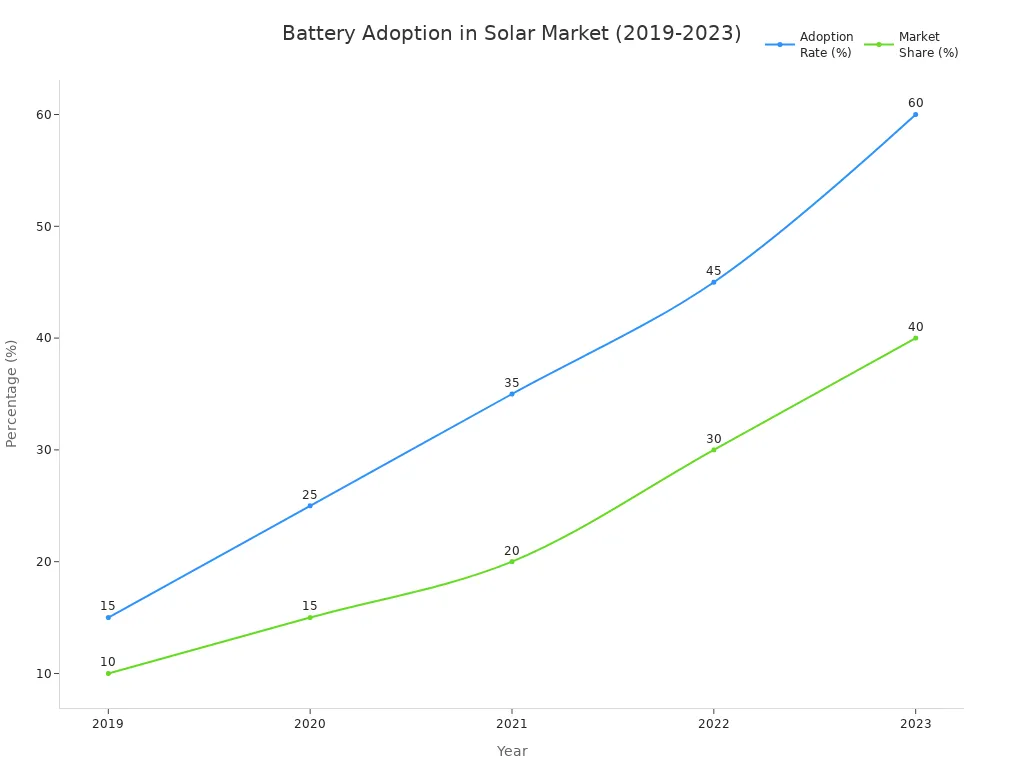
Lithium-ion batteries, like LiFePO4, are very popular for solar systems. They last a long time and work well. They can be used 5,000 to 7,000 times. This makes them a good choice for your money.
Pick a battery that matches how much energy you use. Think about how much power it can hold and give. Also, check how much energy you can use safely. This helps make sure your home has enough power.
Try to find all-in-one options like BEINENG Home ESS. These are easy to set up. They store energy, give backup power, and can charge EVs in one system.
When you look for Solar System Batteries, you see many choices. Some of the most recommended models include BEINENG Home ESS, Tesla Powerwall 3, Bluetti EP900, and Enphase IQ 5P. You also find brands like Qcells, HomeGrid, BYD, and LG Chem. Experts often suggest batteries such as Pytes E-Box 48100R, BigBattery KONG, Fortress eVault, SimpliPhi Power PHI, Ark Lithium, Rich Solar, Mammoth RE PRO, EG4, SOK, and Jakiper. These batteries work well for both off-grid and grid-tied systems.
Tip: BEINENG Home ESS stands out because it gives you an all-in-one solution. You can use it for solar power, energy storage, backup, and even EV charging. It fits many homes and is easy to control with its app.
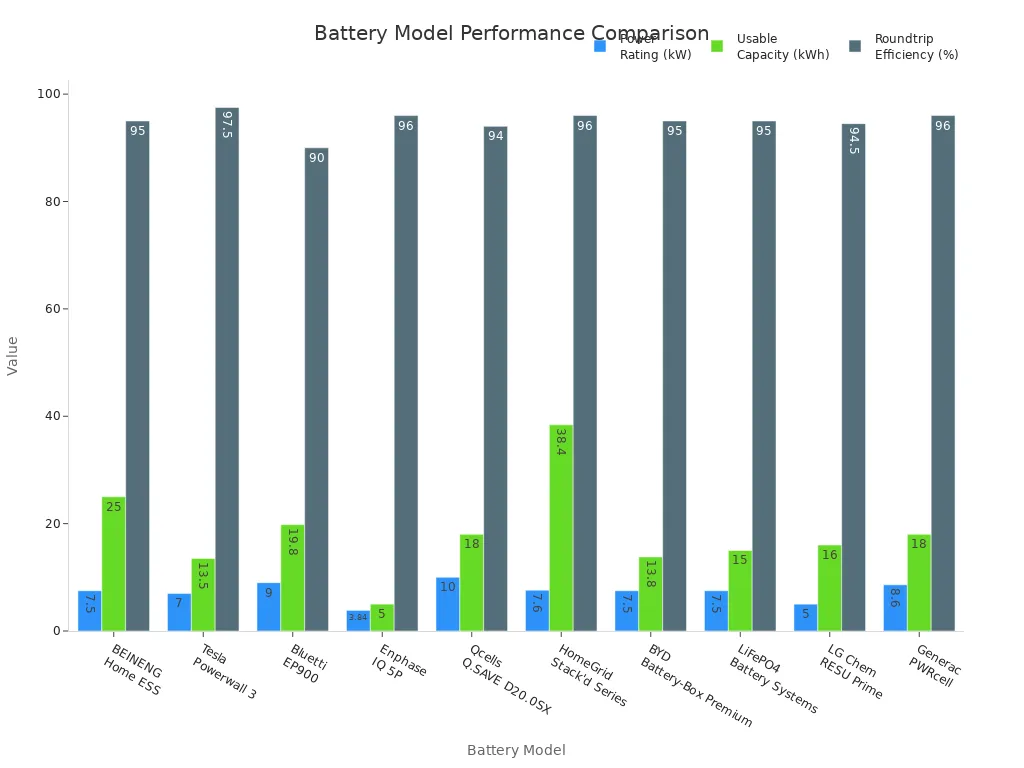
Let’s compare some top Solar System Batteries side by side:
Battery Model | Chemistry | Power Rating | Usable Capacity | Roundtrip Efficiency | Warranty |
|---|---|---|---|---|---|
BEINENG Home ESS | LFP | 5-10 kW | 10-40 kWh+ | 95%+ | 10 years |
Tesla Powerwall 3 | LFP | 7 kW | 13.5 kWh | 97.5% | 10 years |
Bluetti EP900 | LFP | 9 kW | 19.8 kWh | 90% | 10 years |
Enphase IQ 5P | LFP | 3.84 kW | 5 kWh | 96% | 15 years |
Qcells Q.SAVE D20.0SX | LFP | 10 kW | 18 kWh | 94% | 10 years |
HomeGrid Stack'd Series | LFP | 7.6 kW | 38.4 kWh | 96% | 10 years |
BYD Battery-Box Premium | LFP | 5-10 kW | 13.8 kWh | 95% | 10 years |
LG Chem RESU Prime | NMC | 5 kW | 16 kWh | 94.5% | 10 years |
Generac PWRcell | LFP | 8.6 kW | 18 kWh | 96% | 10 years |
You can use LiFePO4 batteries for off-grid cabins, homes, and even RVs. They work well for storing solar energy and keeping your lights on during outages. BEINENG Home ESS is great if you want a smart, safe, and flexible system for your house. Many people choose modular systems for easy upgrades, but all-in-one solutions like BEINENG make things simple and reliable.
If you want to live off the grid, you need a battery that works every day. It should keep your home running after sunset. Most people now pick lithium-ion batteries for this. LiFePO4 models are very popular for off-grid solar. You will see brands like BEINENG Home ESS, Mammoth RE, EG4, and SOK a lot. These brands are known for being reliable and lasting a long time.
BEINENG Home ESS gives you everything in one system. It stores solar energy, gives backup power, and can charge your EV. Mammoth RE and EG4 have batteries you can stack to make them bigger. SOK is liked because it is easy to use and works well. All these batteries are good for cabins, tiny homes, and faraway places.
Tip: Want a simple setup? Pick Solar System Batteries that have storage, monitoring, and backup in one box. This makes it easier to install and take care of.
Let’s see why these batteries are good for off-grid living:
Long Cycle Life: LiFePO4 batteries last 3,000 to 7,000 cycles before they drop to 80% capacity. You can use them every day for over ten years.
High Depth of Discharge: You can use 80% to 95% of the battery’s energy without hurting it. Lead-acid batteries only let you use about half.
Low Maintenance: You do not need to check water or clean them. Just set them up and use them.
Safety: LiFePO4 batteries are safe and steady. They handle hot and cold weather and do not catch fire easily.
Efficiency: These batteries waste less energy when charging and using power. You get more power from your solar panels.
Here is how LiFePO4 batteries compare to lead-acid batteries:
LiFePO4 batteries last 5,000 to 7,000 cycles at 80% depth of discharge.
Lead-acid batteries last only 300 to 500 cycles.
LiFePO4 batteries work well in hot or cold weather.
You get more energy in a smaller and lighter battery.
You might pick BEINENG Home ESS if you want a smart system with backup and EV charging. Mammoth RE and EG4 are good if you want to make your system bigger later. SOK batteries are great for DIY setups and small homes.
When you shop for Solar System Batteries for off-grid use, look for these things:
Capacity: Pick a battery that stores enough energy for your daily needs. Off-grid homes often need 10 kWh or more.
Cycle Life: Choose batteries that last thousands of cycles. LiFePO4 batteries can reach 6,000 cycles or more at 80% depth of discharge.
Maintenance-Free: LiFePO4 batteries do not need regular checks or water refills.
Safety Certifications: Good brands meet strict safety rules. Here are some important certifications:
Standard | Description |
|---|---|
IEC 62619 | Safety for battery systems |
IEC 62133 | Safety for portable batteries |
UL 1973 | Safety for stationary battery applications |
Temperature Range: LiFePO4 batteries work from -20°C to 60°C. You do not have to worry about very hot or cold weather.
Environmental Impact: These batteries do not use harmful heavy metals and are easier to recycle.
Why do so many people like LiFePO4 for off-grid solar? You get more energy, a longer life, and less trouble. The batteries are lighter, safer, and work better. Even though they cost more at first, you save money over time because you do not need to replace them often.
If you want a battery that works every day for many years, LiFePO4 is a great choice.
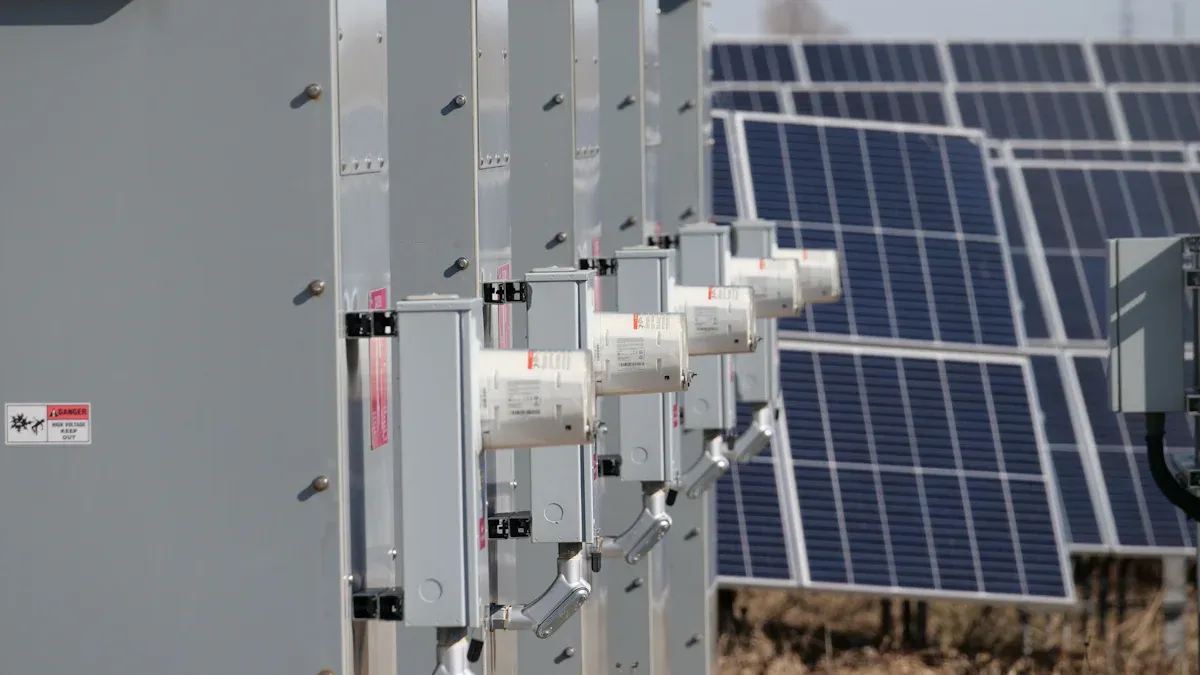
If you want to stay on the grid but also have backup power, you have good choices. BEINENG Home ESS is special because it gives you solar energy storage, backup power, and EV charging in one system. You can use an app to control everything, which makes it simple to manage your energy. Other top batteries are Enphase IQ 5P and Franklin aPower2. These batteries are great for homes that want to save money and keep the lights on if the power goes out.
Battery Model | Usable Capacity | Peak Power | Continuous Power | Round-trip Efficiency | Warranty |
|---|---|---|---|---|---|
BEINENG Home ESS | 10-40 kWh+ | 10 kW | 5-10 kW | 95%+ | 10 years |
Enphase IQ 5P | 5 kWh | 7.68 kW | 3.84 kW | 90% | Up to 15 years |
Franklin aPower2 | 15 kWh | 15 kW | 10 kW | 89% | Up to 15 years |
Grid-tied Solar System Batteries give you many benefits. You can use stored solar energy at night or when the power goes out. These systems help you save money by using energy when it costs less. You get backup power for things like your fridge and lights. Some batteries, like BEINENG Home ESS, let you charge your EV with solar power.
Note: If the grid stops working, your solar panels will not work unless you have a battery. With a battery, your system can keep running and power your home during outages.
Grid-tied batteries are good for homes and businesses that want backup power, lower bills, and more control over energy use.
When you shop for a grid-tied battery, look for these features: Efficiency is important because higher round-trip efficiency means you get more energy to use. BEINENG Home ESS and other top batteries give you 90% or more. Warranty matters too. Most batteries have a 10-year warranty, but some, like Enphase and Franklin, give up to 15 years. System Integration is helpful. BEINENG Home ESS uses smart integration, so you can add it to your solar setup. Many batteries use AC coupling, which lets you connect a battery to your inverter and power important things during outages. Backup Power is another feature. These batteries can make a microgrid, so your home keeps working even if the grid is down. Flexible Use Cases mean you can use grid-tied batteries for backup, saving money, and charging your EV.
Grid-tied Solar System Batteries help you feel safe, save money, and make your home more independent.
Choosing the right battery for your solar system can seem hard. You can make it easier by thinking about a few main things. First, think about how much energy you use every day. Also, think about how much power you need at one time. Check the battery’s capacity and power rating to see if they fit your needs. Look at the depth of discharge. This tells you how much energy you can use without hurting the battery. Efficiency is important too. If a battery is more efficient, you get more energy to use. You should also look at the warranty and how long the battery will last.
Here is a table to help you compare:
Factor | What It Means |
|---|---|
Capacity & Power | How much energy the battery stores and delivers |
Depth of Discharge (DoD) | How much of the battery you can use safely |
Efficiency | How much energy you get out compared to what you put in |
Lifespan and Warranty | How long the battery lasts and what the warranty covers |
The weather where you live matters a lot. If you live somewhere hot, like Arizona, you need a battery that works well in heat. You also want one that can store a lot of energy. If you live in a cold place, pick a battery that works well in cold weather.
Tip: Do not just look at the price. Think about how long the battery will last and how much money you can save over time.
You should pick a battery that matches how you live. Off-grid systems cost more at first because you need more storage and backup. These are best if you live far from the city or want to make all your own power. Grid-tied systems cost less to set up and take care of. They connect to the power company, so you can save money and still have backup if the power goes out.
Aspect | Off‑Grid Battery Systems | Grid‑Tied Battery Systems |
|---|---|---|
Sizing focus | Days of autonomy, peak surges | Bill savings, backup runtime |
Best use cases | Remote homes, unreliable grids | Urban homes, cost savings, backup |
Resilience profile | Fully self-reliant | Strong backup with grid connection |
If you want to make your system bigger later, pick a battery that lets you add more storage. Always make sure your battery works with your other equipment. Try not to make mistakes like picking a battery that does not match or not getting help from a pro. Solar System Batteries cost a lot, so take your time and choose the one that works best for you.
You can pick batteries like BEINENG Home ESS or LiFePO4. These are good choices for your solar system. Make sure the battery fits what you need. You can use online calculators to help you decide. You can also ask experts for advice. Here are some tools you can try:
Calculator Name | Best For |
|---|---|
PVWatts Calculator | Home solar systems |
Off-Grid Solar Calculator | Off-grid setups |
Think about how much energy you will need later. Choose a battery that you can make bigger if you need to.
Helps you use your own energy
Lets you use more solar power
Works with electric vehicles
Most solar batteries last 10 years or more. You can expect 5,000 to 7,000 cycles from a good LiFePO4 battery.
Yes, you can expand most systems. Just make sure your inverter and setup support extra batteries before you buy.
You do not need a battery, but it helps. With a battery, you can use solar power at night or during outages.


Compact, quiet, and powerful, it keeps your essentials running during outages and lets you charge anywhere with solar power or grid power.
Perfect for renters who need flexibility without compromise.
Our estimator is only set up to provide preliminary estimates and installer information to residents of single family homes.