
 Email Us
 Contact us
 Whats App
Single family home


Choosing the best batteries for your solar system starts with knowing how much energy you use each day. You also need to know how much backup power you want. Battery capacity is important. It decides how much energy you can keep. It also affects how much your home depends on the grid. Recent studies show:
Picking the right battery size does more than meet basic needs. It helps you save money. It gives backup for important devices.
A home powered only by solar can run all its electricity needs with solar panels and battery storage. This makes your home self-sufficient.
You can make this easier with a solution like the BEINENG Home ESS. It is scalable and easy to use.
Know how much energy you use each day. This helps you pick the right battery size for your solar system. Think about amp-hours (Ah) and kilowatt-hours (kWh) when you choose batteries. These numbers help match batteries to your energy needs. Plan for days when you need backup power. This is important for cloudy days or power outages. Lithium-ion batteries last longer and work better than lead-acid batteries. They are often the best choice. Pick a battery system that can grow with you, like BEINENG Home ESS. This lets you add more storage if you need it later.
Battery capacity means how much energy a battery can hold and give out. You measure it in amp-hours (Ah) or kilowatt-hours (kWh). Most homes use kilowatt-hours for solar systems. This matches what homes need for energy. A battery with more capacity can run more things for longer. How much energy a battery holds depends on its design, the stuff inside, and how fast you use it.
Amp-hours (Ah) tell you how long a battery can run things based on the current.
Kilowatt-hours (kWh) show the total energy your home can use.
Battery capacity also depends on how much you use before charging again. This is called depth of discharge.
Tip: When picking the Best Batteries for your solar system, look at both Ah and kWh numbers. These help you choose a battery that fits your daily energy use.
Battery capacity is very important for your solar system. If your battery is too small, you might lose power when it is cloudy or at night. This can cause blackouts and make you upset. A battery with enough capacity keeps your lights and devices working, even when there is no sun.
You need enough battery storage for times when solar panels do not make much energy.
Bigger batteries give more backup power during outages. For example, a 10 kWh battery can run important things for about 24 hours.
The usable capacity of your battery depends on how deep you use it and how well it works.
Taking care of battery charge cycles can help your battery last longer and keep your system working well.
LiFePO4 batteries work better and last longer than lead-acid batteries. They let you use more stored energy and need fewer changes. Picking the Best Batteries gives you better results and helps you feel safe. You also get more energy freedom and save money over time.
You need to know how much energy your home uses each day before choosing the Best Batteries for your solar system. Start by looking at your electricity bills from the past year. Add up the kilowatt-hours (kWh) for each month and divide by 12 to get your average monthly usage. Divide that number by 30 to find your daily energy use.
You can also check each appliance in your home. Find the wattage on the label. Estimate how many hours you use it each day. Use this formula:
Daily kWh = (Wattage × Hours Used Per Day) ÷ 1000Add up the daily kWh for all your appliances. This gives you a clear picture of your total daily energy needs.
Tip: Some utility companies offer Green Button Data. This lets you download your energy use history for more accurate results.
Days of autonomy means how many days you want your batteries to power your home without sunlight. If you live in an area with frequent cloudy weather or outages, you may want more days of autonomy. More autonomy means you need a bigger battery bank.
Here is a table that shows how days of autonomy affect reliability and cost:
Autonomy Days | System Reliability | Upfront Cost | Ideal Use Case |
|---|---|---|---|
1 Day | Good | Lower | Grid-tied homes with stable power and short outages |
2 Days | Excellent | Moderate | Off-grid homes or places with less reliable grids |
3+ Days | Exceptional | Higher | Remote homes or places with harsh winters |
Choosing the right number of autonomy days helps you balance cost and peace of mind.
Once you know your daily energy use and days of autonomy, you can calculate the battery capacity you need. Use this formula:
Battery Capacity (kWh) = (Average Daily Energy Use × Days of Autonomy) ÷ (Depth of Discharge × System Efficiency)Depth of discharge (DoD) shows how much of the battery’s energy you can use. Most lithium-ion batteries, like those in the BEINENG Home ESS, have a DoD of 80-90%. System efficiency is usually around 85-95%.
Let’s look at a practical example:
Your home uses 30 kWh per day.
You want 2 days of autonomy.
Your battery’s DoD is 90%. System efficiency is 90%.
Plug in the numbers:
Battery Capacity = (30 kWh × 2) ÷ (0.9 × 0.9) = 60 ÷ 0.81 ≈ 74 kWhYou need about 74 kWh of battery storage for two days of backup. If you start with a 10 kWh battery, it will cover about 8 hours of full use. You can add more BEINENG Home ESS modules as your needs grow. The system is scalable and lets you expand easily.
To find amp-hour (AH) capacity, use this formula:
Amp-Hours (AH) = (Total Watt-Hours) ÷ (System Voltage)For example, if you need 10,000 watt-hours (10 kWh) and use a 48V system:
AH = 10,000 ÷ 48 ≈ 208 AHSystem voltage affects how your batteries work and how efficient your solar system is. Higher voltage systems need less current. This means you can use smaller wires and lose less energy as heat. Most homes use 12V, 24V, or 48V systems.
Here is a table that shows how voltage changes the amp-hour needs for a 5 kWh battery bank:
System Voltage | Required Amp-Hours (AH) |
|---|---|
12V | 417 AH |
24V | 208 AH |
48V | 104 AH |
Higher voltage systems are simpler and safer. They need fewer parallel connections and have fewer points where things can go wrong.
Note: The BEINENG Home ESS supports flexible voltage options and stackable battery modules. You can choose the setup that fits your home and expand it as your energy needs grow.
Choosing the Best Batteries for your solar system means matching your daily use, autonomy days, and system voltage. With a scalable solution like BEINENG Home ESS, you can start small and add more power as your needs change.
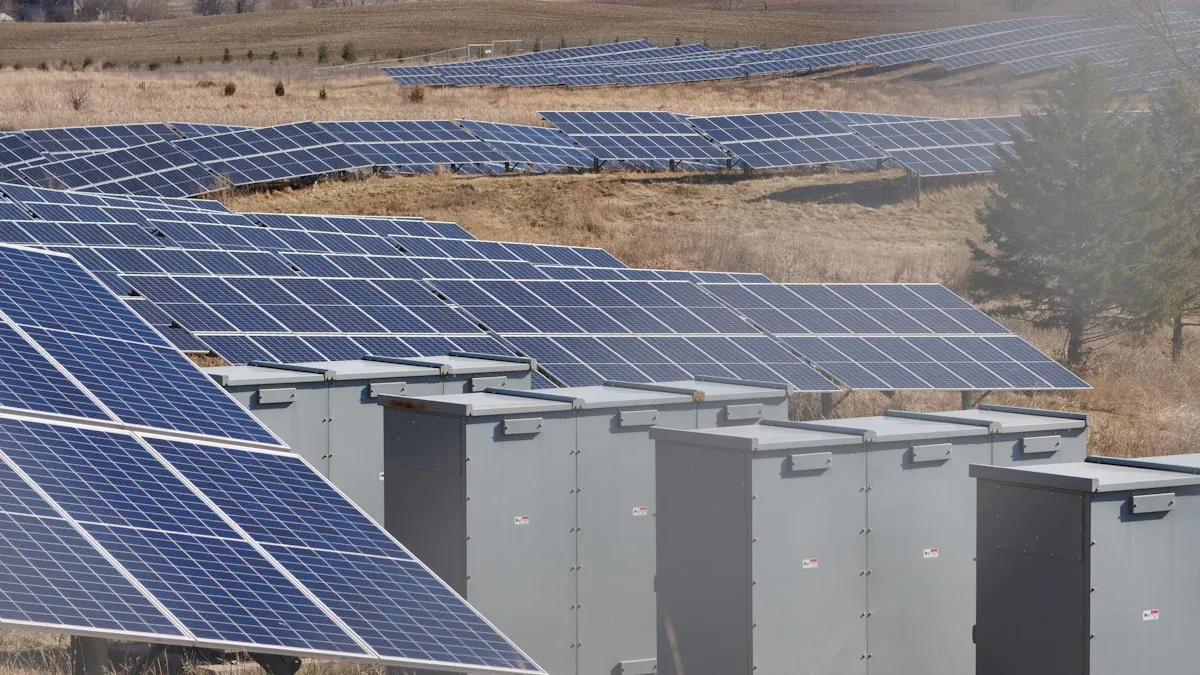
When you pick batteries for your solar system, you often look at lead-acid and lithium-ion batteries. These two types are different in many ways. It is important to know how each one works before you decide.
Lithium-ion batteries are more reliable and work better. They last longer than lead-acid batteries. You can use more of their energy without hurting them. Lead-acid batteries cost less at first, but you have to buy new ones more often. They lose energy faster and do not hold as much power.
Here is a table that shows the main differences:
Feature | Lithium-ion | Lead-acid |
|---|---|---|
Lifespan | 2000 - 5000 cycles | < 1000 cycles |
Cost | Higher upfront cost | More cost-effective |
Capacity | Higher energy storage | Lower energy storage |
Depth of Discharge | 85% | 50% |
Efficiency | 95% | 80-85% |
Lithium-ion batteries can last for 10 years or more. Lead-acid batteries last only 3 to 5 years. You get more uses with lithium-ion, so you do not need to change them as much. This makes them a better choice for most homes.
Note: Lithium-ion batteries save you money over time because you do not have to buy new batteries every few years.
There are other battery types for solar systems. Some new batteries have special features. Here are some examples:
Sodium-ion batteries
Water-based batteries
Vanadium-redox flow batteries
Zinc-polyiodide flow batteries
Organic aqueous flow batteries
Sodium-metal halide batteries
Zinc-air batteries
Zinc-manganese oxide batteries
Flow batteries and saltwater batteries are two types you might see for homes. Flow batteries last a long time and are easy to make bigger. Saltwater batteries are safe and good for the environment. Both types cost more and need more space.
Battery Type | Pros | Cons |
|---|---|---|
Saltwater Batteries | Long lifespan, Eco-friendly, 100% DoD, Safe | Expensive, Lower energy density, Few products |
Flow Batteries | Scalability, Long lifespan, Green | High cost, Needs space, Regular maintenance |
You can think about these batteries if you want something different from lead-acid or lithium-ion. Most people still use lithium-ion batteries because they work well and last longer.
When you choose batteries for your solar system, you should look at how long they last, how well they work, and how much they cost. These things change how much you pay and how your system runs.
Lithium-ion batteries last 10 to 20 years and work 90-95% of the time.
Lead-acid batteries last 3 to 5 years and work 70-80% of the time.
Lithium-ion batteries cost more at first, but you save money because they last longer.
Solar batteries can cost $5,000 to $7,000, depending on the type and size.
Battery Type | Lifespan (Years) | Efficiency (%) | Cost (per kWh) |
|---|---|---|---|
Lithium-ion | 10 - 20 | 90 - 95 | $271 |
Lead-acid | 3 - 5 | 70 - 80 | $260 |
Pick batteries that fit your needs and your budget. Lithium-ion batteries are the best for most homes because they last longer and work better.
Tip: Battery prices and how well they work keep getting better. More people want clean energy, and governments help support solar power.
You want a battery system that is easy to use and can grow with you. The BEINENG Home ESS gives you these things. You can start with one battery and add more if you need them. The system lets you mix old and new batteries. You get backup power when the lights go out. You can use it for both off-grid and grid-tied homes.
BEINENG Home ESS is good for homes that want to use their own energy. You can set it up easily and control it with smart tools. The system also lets you charge your electric car with solar power.
Callout: BEINENG Home ESS helps you build a solar system that is flexible and ready for the future. You get steady power, easy upgrades, and simple controls.
You should think about BEINENG Home ESS if you want the best batteries for your solar system. It works for many homes and helps you feel safe.
You need to know if your solar system will work off-grid or with the grid. Off-grid systems give you full energy independence. Grid-tied systems let you use both solar and the utility grid. Each setup has different needs for batteries.
Consideration | Off-Grid Systems | Grid-Tied Systems |
|---|---|---|
Primary Goal | Energy independence, power for remote areas | Backup power, bill reduction, grid support |
Reliability | Depends on system size, weather, and backup generator | High, uses grid and battery backup |
Complexity | Higher, needs careful design for self-sufficiency | Moderate, must follow grid rules |
Battery Sizing | Larger capacity for multi-day autonomy | Sized for backup and energy management |
Cost Implications | Higher upfront cost, bigger battery bank | Lower upfront, grid acts as backup |
Off-grid systems need bigger batteries. You must plan for days when the sun does not shine. Grid-tied systems can use smaller batteries because the grid helps during outages.
You should think about the future when you size your battery system. Your energy use may grow. You might add more solar panels or buy an electric car. Planning ahead saves money and trouble later.
Think about future load growth and possible home upgrades.
Make sure your electrical panel has space for new circuits.
Choose a charge controller that can handle more solar panels.
Pick a battery system that lets you add more units easily.
Leave room for more batteries and other parts.
Modular and stackable battery systems, like BEINENG Home ESS, help you expand. You can start small and add more batteries as your needs grow. Each unit works on its own, so you do not waste your first investment.
You must decide how much backup power you want. Some people only back up lights and fridges. Others want to power the whole house for days. Your home size and needs will guide your choice.
Home Size | Essential Backup (kWh) | Whole-home Backup (kWh) | Extended Backup (kWh) |
|---|---|---|---|
Small Homes (1,000-1,500 sq ft) | 10-15 (1-2 days) | 20-25 (1-2 days) | 30-40 (3-4 days) |
Medium Homes (1,500-2,500 sq ft) | 15-20 (1-2 days) | 25-35 (1-2 days) | 40-60 (3-4 days) |
Large Homes (2,500+ sq ft) | 20-30 (1-2 days) | 35-50 (1-2 days) | 60-80+ (3-4 days) |
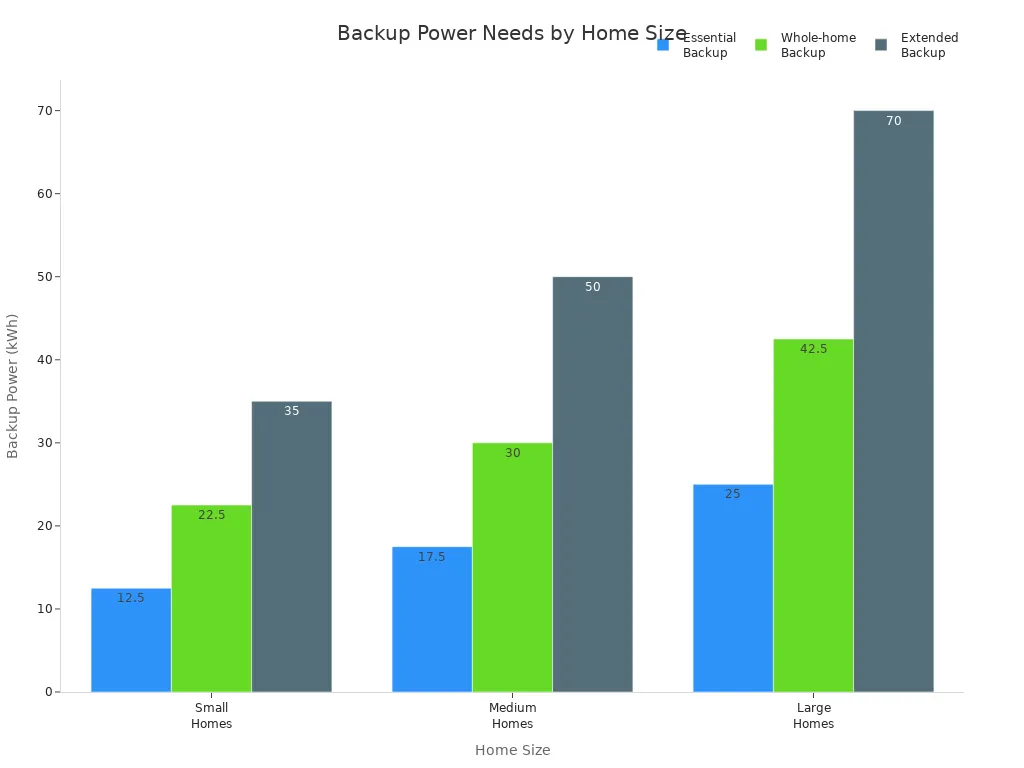
Tip: You should match your battery size to your backup needs. This helps you stay comfortable during outages and keeps your home running smoothly.
To pick the best batteries for your solar system, you need to do a few things. First, look at your electricity bills to see how much energy you use. Next, make a list of appliances you want to keep on if the power goes out. Then, figure out how much power your solar panels can make. Also, think about how much energy you might need in the future. It is smart to talk to experts for help.
If you do the math right and choose the right battery, you can save money. You will also use more of your own energy. A system like BEINENG Home ESS lets you add more batteries when you need them. This helps you control your energy and save even more.
You should check your daily energy use on your electric bill. Multiply that by the number of backup days you want. Divide by the battery’s depth of discharge and system efficiency. This gives you the right battery size.
Yes, you can expand your battery bank. The BEINENG Home ESS lets you stack new modules with old ones. You can grow your system as your energy needs change.
Unit | What It Measures | Example Use |
|---|---|---|
kWh | Total energy | Home energy use |
Ah | Battery capacity | Battery specs |
You use kWh for home energy. You use Ah for battery details.
You need batteries with high capacity and long life for off-grid systems. Lithium-ion batteries, like those in BEINENG Home ESS, work well. They give you reliable power when you do not have grid access.


Compact, quiet, and powerful, it keeps your essentials running during outages and lets you charge anywhere with solar power or grid power.
Perfect for renters who need flexibility without compromise.
Our estimator is only set up to provide preliminary estimates and installer information to residents of single family homes.