
 Email Us
 Contact us
 Whats App
Single family home


You should pick a Solar Battery Backup system that works for your home. It helps keep your family safe when there is an emergency. First, think about which appliances you need most if the power goes out. Most people say they want a battery system to stay safe during outages. You can feel calm knowing your lights and devices will work, even in storms. Some people also like being able to use battery power alone or with the grid. If you have the right facts, you can choose a system that fits your needs and gives you steady energy.
Pick a Solar Battery Backup system by thinking about your most important appliances. This helps keep them running when the power goes out.
Learn about battery types, such as lithium-ion and lead-acid. This will help you pick one that works for your needs and money.
Think about how much energy you use now and may use later. This helps you choose the right battery size for your home.
Check for safety labels and features. This makes sure your battery system is safe and works well.
Look for deals and rebates that can help you save money on your Solar Battery Backup system.
A Solar Battery Backup system helps you keep your home powered when the grid goes down. You use sunlight to make electricity with solar panels. The system stores extra energy in a battery. When you need power at night or during an outage, the battery sends electricity to your home. This setup gives you peace of mind because you know your lights and important devices will keep working.
A Solar Battery Backup system has three main parts. You have solar panels on your roof. These panels collect sunlight and turn it into electricity. The system also includes a solar inverter. The inverter changes the electricity from the panels into a form your home can use. The last part is the battery bank. The battery stores extra energy for later. This way, you always have power, even if the grid fails.
Tip: You can use a Solar Battery Backup to save money, too. You store energy when the sun is shining and use it when electricity costs more.
You might wonder how a Solar Battery Backup system actually keeps your home running. Here’s a simple breakdown:
Step | Description |
|---|---|
1 | Solar panels generate electricity during the day. |
2 | The solar inverter converts DC electricity to AC for home use. |
3 | Excess electricity charges the battery. |
4 | In case of a power outage, the system switches to backup mode. |
5 | The battery discharges stored energy to power the home. |
6 | The inverter converts the battery's DC output back to AC. |
You get power from the sun during the day. If you make more than you use, the battery stores the extra. When the grid goes out, the system switches to backup mode. The battery then sends power to your home. You do not have to worry about losing electricity during storms or at night.
You want your home to be safe during a power outage. A Solar Battery Backup helps you feel calm. When the grid stops working, your system keeps your lights on. It also keeps your fridge and other important devices running. You do not have to worry about food going bad. You will not miss important news. About 40% of homeowners use battery backup for emergencies. More than half say staying safe during outages is the main reason.
Keeps your important appliances working when the power goes out
Turns on by itself when the power fails
Lets your solar panels fill the battery, so you have power in long outages
You can feel good knowing your home will stay bright, even in bad weather.
You may want more control over your energy. With a Solar Battery Backup, you can make and store your own electricity. You do not need to rely on the public grid as much. You get to choose when and how you use your power. Many people like this freedom. It helps when utility prices rise or the grid is not reliable.
You control your energy use based on what you need
You are less affected by power company outages or schedules
You can even live off-grid if you want
Picking solar and battery storage helps you become more independent.
Saving money is always helpful. With a Solar Battery Backup, you can use stored energy when electricity costs more. If you have a time-of-use plan, you charge your battery when rates are low. You use it when rates are high. This helps you avoid paying extra during busy hours. Some people save more by storing extra solar energy for later.
You avoid paying high prices during busy times
You use more clean energy and less fossil fuel power
You help lower carbon emissions and make your home greener
A study shows using solar and batteries together can cut greenhouse gas emissions by up to 80%. You save money and help the planet at the same time.
Choosing the right Solar Battery Backup system for your home can feel like a big task. You can break it down into simple steps. Let’s walk through the most important factors you should consider.
You want to make sure your backup system can handle what matters most. Here’s how you can figure out your power needs:
Check your energy bills. Look for your average daily and monthly usage. Notice if you use more power in summer or winter.
Make a list of the appliances you want to keep running during an outage. Most people pick the fridge, lights, Wi-Fi, and maybe medical devices.
Find out how much electricity your solar panels produce. This helps you know how much energy you can store.
Think about the future. Will you add an electric car or new appliances soon?
Ask an energy expert for advice. They can help you pick the right battery size.
Tip: Write down your “must-have” devices and their wattage. Add up the numbers to see how much backup power you need.
Not all batteries are the same. You’ll find a few main types in home backup systems. Each has its own strengths.
Battery Type | Advantages | Drawbacks |
|---|---|---|
LFP (Lithium Iron Phosphate) | Very safe, lasts a long time, handles heat well | None noted |
NMC (Nickel Manganese Cobalt) | Packs more energy in a small space | Doesn’t like high heat, shorter life |
SLA (Sealed Lead Acid) | Cheaper upfront | Heavy, stores less energy, doesn’t last as long |
You’ll also see differences in how long batteries last and how much care they need:
Battery Type | Lifespan | Maintenance | Energy Density |
|---|---|---|---|
Lead-acid (Flooded) | 2-5 years | Needs regular checks | Lower |
Lead-acid (Sealed) | 3-5 years | No maintenance | Lower |
Lithium-ion | 5-10 years | Very little care | Higher |
Note: Lithium-ion batteries are popular because they last longer and need less attention.
Capacity tells you how much energy your battery can store. Runtime shows how long it can power your home. You want a battery that matches your needs.
If you only want to keep the lights and fridge on, a smaller battery may work.
If you want to run more devices or go off-grid, you’ll need a bigger system.
Check the battery’s kilowatt-hour (kWh) rating. This number shows how much energy it holds.
Think about how long you want backup power during an outage. Some batteries last a few hours, others can run for days if you use less power.
Tip: Choose a system that covers your “must-have” devices for at least 8-12 hours.
You need your new battery to work with your current solar setup. Here’s what to check:
Make sure your solar panels can connect to a battery.
See if your inverter is “battery-ready.” Some inverters, like Enphase microinverters or Sol-Ark Hybrid Inverters, make this easy.
Look at the battery’s size and type. Make sure it fits your home and your energy needs.
Battery-ready inverters help manage energy flow. They charge and discharge the battery at the right times.
Ask your installer if your system is ready for a battery. If not, see what upgrades you need.
Installing a Solar Battery Backup system takes planning. Here’s what usually happens:
Installation Steps | Description |
|---|---|
Site assessment and load evaluation | Experts check your home and figure out your power needs. |
Permitting and utility coordination | You get the right permits and work with your utility company. |
Professional installation | Installers set up your system. This can take 1 to 5 days. |
System walk-through | You learn how to use and monitor your new system. |
After installation, you should:
Use an app to check your system’s performance.
Schedule a yearly checkup.
Keep your system’s software up to date.
Modern lithium batteries last 10 to 15 years and need little care. Place your battery in a cool, dry spot like a garage or utility room. Make sure it’s easy to reach but safe from heat and moisture.
Safety comes first. Look for these standards and features:
Safety Standard/Certification | What It Means |
|---|---|
NFPA 855 | Safe spacing for battery systems |
NEC 706 | Rules for disconnecting batteries |
UL 9540/9540A | Certified safe energy storage |
Exterior 'ESS Shutoff' label | Lets first responders cut power fast |
3 ft clearance | Space around the battery for safety |
Pick batteries that pass tough safety tests.
Make sure they have built-in protection against overcharging, overheating, and short circuits.
Good design helps with airflow and keeps the battery safe.
Tip: Ask your installer about local codes and safety rules.
You want to know what you’ll pay and how you can save. Here’s a breakdown:
Cost Component | Description |
|---|---|
Hardware | Battery, inverter, wiring, and other parts. |
Labor | Licensed electricians do the installation. |
Permitting | You’ll need permits and inspections. |
Overhead | Manufacturer and supplier fees. |
Total Cost | Most homes pay $15,000 to $18,000 installed, or $1,200–$1,400 per kWh. Large systems can cost over $20,000. |
You can lower your cost with incentives:
Incentive Type | What It Does |
|---|---|
Federal Tax Credit | Get 30% back on your system’s cost. |
Local Incentives | Some states and utilities offer rebates, grants, or loans. |
Net Metering | Sell extra solar power back to the grid for credit. |
Renewable Energy Certificates (RECs) | Earn certificates for your clean energy and sell them for cash. |
Some states have special programs that pay you for sharing stored power with the grid during busy times.
Tip: Ask your installer or utility company about all the rebates and programs you can use.
By looking at these key factors, you can match the right Solar Battery Backup system to your home’s needs. Take your time, ask questions, and choose a system that gives you peace of mind.
There are many choices for Solar Battery Backup. Some brands are known for being reliable and having good features. Here are some top brands you might see:
BEINENG Home ESS: This system has solar, battery, and EV charging. You can use the myBeineng App to control it.
Tesla Powerwall 3: This is a very popular home battery. It is easy to use and works with many solar systems.
Generac PWRcell 2: This brand uses advanced technology and lets you change storage size.
Goal Zero: These are portable and good for small homes or cabins.
EcoFlow: These charge fast and you can add more parts if needed.
Enphase IQ 5P: Installers trust this brand. It comes with a 15-year warranty.
BLUETTI: This brand is good for both portable and home backup.
Panasonic Evervolt: This is a reliable and high-quality choice.
Canadian Solar EP Cube: This system is modular and efficient.
FranklinWH aPower 2: This has a large capacity and a long warranty.
You can choose a system that fits your home and energy needs.
There are two main battery types: lithium-ion and lead-acid. Each type has good and bad points.
Battery Type | Advantages | Disadvantages |
|---|---|---|
Lead-Acid (Flooded) | Cheapest and has worked for many years | Needs care, does not last long, needs airflow |
Lead-Acid (Sealed) | No maintenance needed | Costs more, does not last long |
Lithium-Ion | Stores more energy, lasts longer, charges fast, safe, works in many places | Costs more |
Lithium-ion batteries last longer and charge quickly. Lead-acid batteries are cheaper but need more care.
You may want to compare battery size and warranty. Here are some top models:
Model | Usable Capacity | Warranty |
|---|---|---|
Tesla Powerwall 3 | 13.5 kWh | 10 years |
FranklinWH aPower 2 | 15 kWh | 15 years |
EP Cube | 15 kWh (modular) | 10 years |
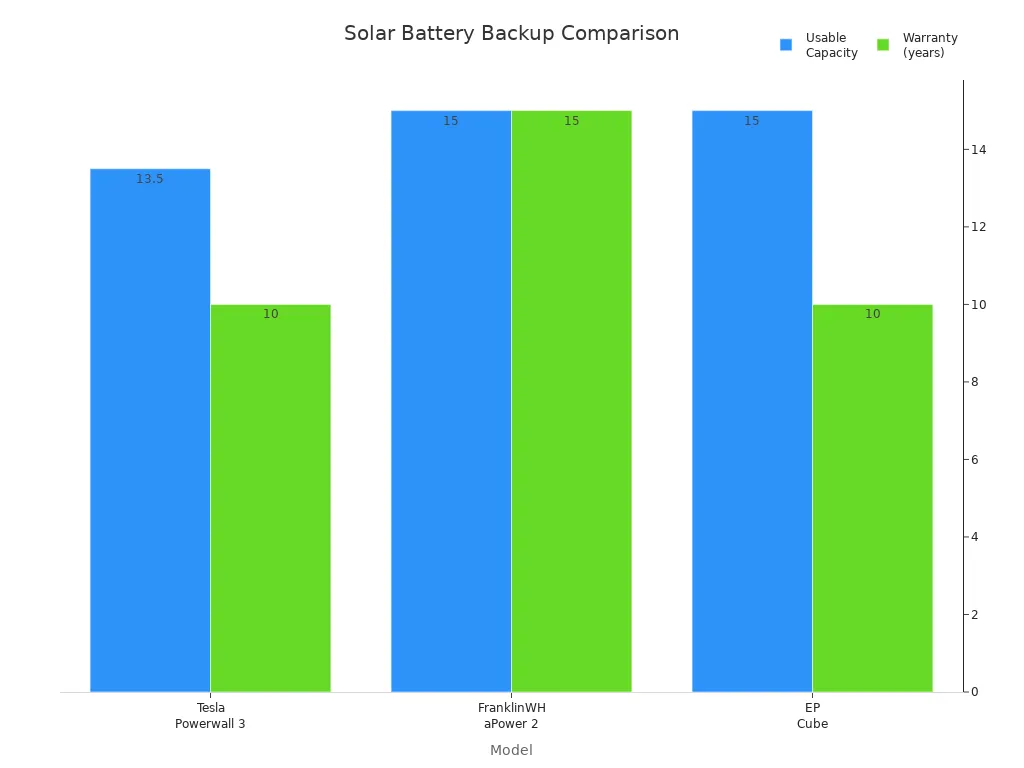
BEINENG Home ESS lets you manage solar, storage, and EV charging together. You can control it easily with an app. Tesla Powerwall 3 is simple and works well. FranklinWH aPower 2 gives you more storage and a longer warranty. EP Cube is modular, so you can add more later.
Think about what is most important to you. You might want more storage, a longer warranty, smart features, or easy control. There is a Solar Battery Backup that will fit your needs.
You want to feel confident before you buy a Solar Battery Backup system. Use this checklist to stay on track:
Figure out your daily energy use. Check your bills and write down how much power you use each day.
List the appliances you want to keep running during an outage. Decide if you need backup for your whole home or just the essentials.
Research battery types. Learn about lithium-ion and lead-acid batteries. Pick the one that fits your needs best.
Check your space. Make sure you have a safe, dry spot for the battery.
Look at your inverter. See if it works with the battery you want.
Review safety features. Make sure the system meets standards like UL 9540.
Think about smart features. Do you want an app to monitor your energy?
Add up the costs. Include installation, maintenance, and possible incentives.
Tip: Keep the area around your battery clean and clear. Never store flammable items nearby.
Do | Don't |
|---|---|
Monitor your system's performance | Ignore warning lights or alarms |
Follow all instructions | Try to service the battery yourself |
Ensure good airflow | Block vents or openings |
You should ask your installer a few key questions before you decide:
What can solar and battery storage do for me?
Should I choose a DC-coupled or AC-coupled system?
What safety measures are in place for this battery system?
How long will installation take?
What kind of warranty and support do you offer?
Asking questions helps you feel sure about your choice.
Now you are ready to decide. Think about these points:
Do you want a grid-tied or off-grid system?
Will you back up your whole home or just a few devices?
Does the battery have enough capacity and power for your needs?
What is the depth of discharge and efficiency?
How long is the warranty?
Take your time. Compare your options. Pick the system that matches your energy goals and budget. When you follow these steps, you can choose a Solar Battery Backup system with confidence.
You have learned the main steps to pick a solar battery backup system. First, look at how much energy your home uses. Next, compare different battery types and their features. Check how much energy each battery can store. Ask questions and talk to installers you trust. If you make a good choice, you get more than just backup power. You will have more control over your energy, save money, and feel safe when the power goes out.
Long-Term Benefit | What You Get |
|---|---|
Energy independence | You do not need the grid as much |
Lower energy bills | You use your solar power better |
Peace of mind | Quiet backup power in emergencies |
Take action now to make your home safer and better for the planet!
You can expect most systems to run essential devices for 8–12 hours. If you use less power, your battery lasts longer. Some larger systems can keep your home running for days.
Yes, you can add a battery to most solar setups. You may need a compatible inverter. Ask your installer to check your system and recommend the best battery option.
You do not need much maintenance. Check your system with an app. Keep the area clean and dry. Schedule a yearly inspection with your installer for best performance.
You can save money by using stored energy when rates are high. Many homeowners see lower bills, especially if they use time-of-use plans or net metering.
Modern batteries have built-in safety features. They protect against overheating and overcharging. Make sure your system meets safety standards like UL 9540 for peace of mind.


Compact, quiet, and powerful, it keeps your essentials running during outages and lets you charge anywhere with solar power or grid power.
Perfect for renters who need flexibility without compromise.
Our estimator is only set up to provide preliminary estimates and installer information to residents of single family homes.