
 Email Us
 Contact us
 Whats App
Single family home

Solar backup batteries keep solar power from your panels for later. You need solar backup batteries to keep lights on if the grid fails. They also help your appliances work when power is out. More homeowners want to save money and have backup power. They also want energy independence. In the last five years, more homes use solar backup batteries. About 15-20% of new solar homes have backup batteries now. People pick backup batteries to use more solar power. They also want to depend less on the utility. Modern systems like BEINENG Home ESS make it easy to manage solar power. You can store energy and have backup power during outages. You feel safe knowing your home has reliable solar backup. You get backup power whenever you need it.
Solar backup batteries keep extra energy from solar panels. You can use this energy later. They give power when the electricity goes out. They help you use less power from the grid.
Picking the right battery type, like lithium-ion or LFP, makes the system work better. It helps the battery last longer. This can save you money and energy.
Installing and sizing your solar battery system the right way is very important. It helps the system work well. You should ask a professional for help. This keeps things safe and follows the rules.
Taking care of your battery often helps it last longer. Simple jobs like checking connections and watching how it works can stop problems.
Using solar battery systems can save you a lot of money. They can also make your home worth more. This makes them a smart choice.
Solar backup batteries let you keep extra solar energy for later. When your solar panels make more power than you need, the extra goes into the battery. You can use this stored energy at night or if the power goes out. This helps you control your energy and save money.
A solar backup battery system has many important parts. Each part helps the batteries work safely and well. The BEINENG Home ESS puts these parts together in one unit. Here is a table that shows the main parts and what they do:
Component | Function |
|---|---|
Battery Management System (BMS) | Manages battery health, monitors status, and ensures safe operation. |
Power Conversion System (PCS) | Converts DC power from batteries to AC for loads and vice versa for charging. |
Energy Management System (EMS) | Controls and schedules operations, optimizing performance based on external data. |
Controller | Monitors and controls the entire system, ensuring optimal operation and safety. |
HVAC | Regulates internal temperature to prevent overheating and extend battery life. |
Fire Suppression | Provides safety measures against thermal runaway and potential fires. |
SCADA | Monitors and controls system components, allowing for operational management and data acquisition. |
Solar batteries, inverters, and controllers all work together. They move energy where it is needed. The battery management system keeps the batteries safe and healthy. The power conversion system changes DC power to AC power for your home. The energy management system helps you use your stored solar energy in the best way.
Solar backup batteries connect to your solar panels and the grid. This setup lets you use solar energy when the sun is out. You use battery storage when it is dark or cloudy. The BEINENG Home ESS makes this easy by putting solar inverters, EV DC chargers, battery packs, and energy management systems in one device.
Here is how a modern system works:
Solar panels collect sunlight and turn it into electricity.
The system sends this electricity to your home, your battery, or both.
If your batteries are full and your home does not need more power, extra energy goes back to the grid.
If the power goes out, your solar batteries give backup power to keep your lights and appliances on.
You can make the BEINENG Home ESS bigger if you need more power. The design lets you add more batteries for more storage. Each stack holds between 5 and 48 kWh. You can add more modules as your energy needs grow. This makes solar energy storage a smart choice for homes and businesses.
The BEINENG Home ESS also lets you charge your electric car. You can use solar energy to charge your EV. This saves you money and helps the planet. The system manages energy flow so you always have power when you need it.
Battery management and monitoring keep your solar backup batteries safe and working well. The battery management system checks each battery cell. It protects against problems like overcharging, overheating, and short circuits. The BMS also tells you how much energy is left, so you know when to recharge.
Modern systems like the BEINENG Home ESS use smart technology to make battery storage safer. The BMS uses sensors to watch voltage, current, and temperature. It can find problems early and fix them before they get worse. Here are some important features of a good battery management system:
Voltage protection keeps the battery safe.
Current protection stops too much current.
Overcharge and overdischarge protection help batteries last longer.
Short circuit protection keeps things safe.
State of charge management tells you how much energy you have.
Temperature regulation keeps batteries cool.
Fault detection and diagnostics help you find and fix problems fast.
Data logging and reporting let you track how your system works.
With the BEINENG Home ESS, you can use the myBeineng app on your phone. You can see how much energy you have stored. You can check your usage and get alerts if something is wrong. This helps you use your solar energy storage in the best way and keeps your home safe.
Modern solar backup batteries also have smart features like smart charging and vehicle-to-grid technology. You can set your system to charge your EV when power is cheapest. Some systems let your EV send power back to your home during an outage. These features make solar batteries a great tool for saving money and having energy when you need it.
When you look for solar batteries, you have many choices. Each type has good and bad points. Knowing these differences helps you pick the best one. Modern systems like BEINENGStor use new battery technology. This gives you strong power and long life.
Lithium-ion batteries are the most common for solar storage. There are two main kinds: lithium-ion and lithium iron phosphate (LFP). Both work well and last a long time. LFP batteries are extra safe and steady. They work in hot or cold weather. You can use almost all their stored energy without hurting them.
Here is a table to help you compare lithium-ion, LFP, and lead-acid batteries:
Battery Type | Efficiency | Discharge Rate | Lifespan | Maintenance | Environmental Impact |
|---|---|---|---|---|---|
Lithium-ion | 20-30% more efficient than lead-acid | Higher due to lower internal resistance | 5-15 years | Maintenance-free | Lower impact due to longer lifespan |
Lead-acid | Less efficient | Lower discharge rates | 3-5 years | Requires regular maintenance | Higher impact due to shorter lifespan |
Lithium-ion and LFP batteries give you more energy to use. They last longer and need less care. Many systems, like BEINENGStor, have a battery management system. This keeps your batteries safe and healthy. It checks voltage, current, and temperature. It also stops overcharging and overheating.
LFP batteries can handle deep discharges. You can use up to all their power. They last for thousands of cycles. Look at this chart to see how LFP batteries last compared to others:
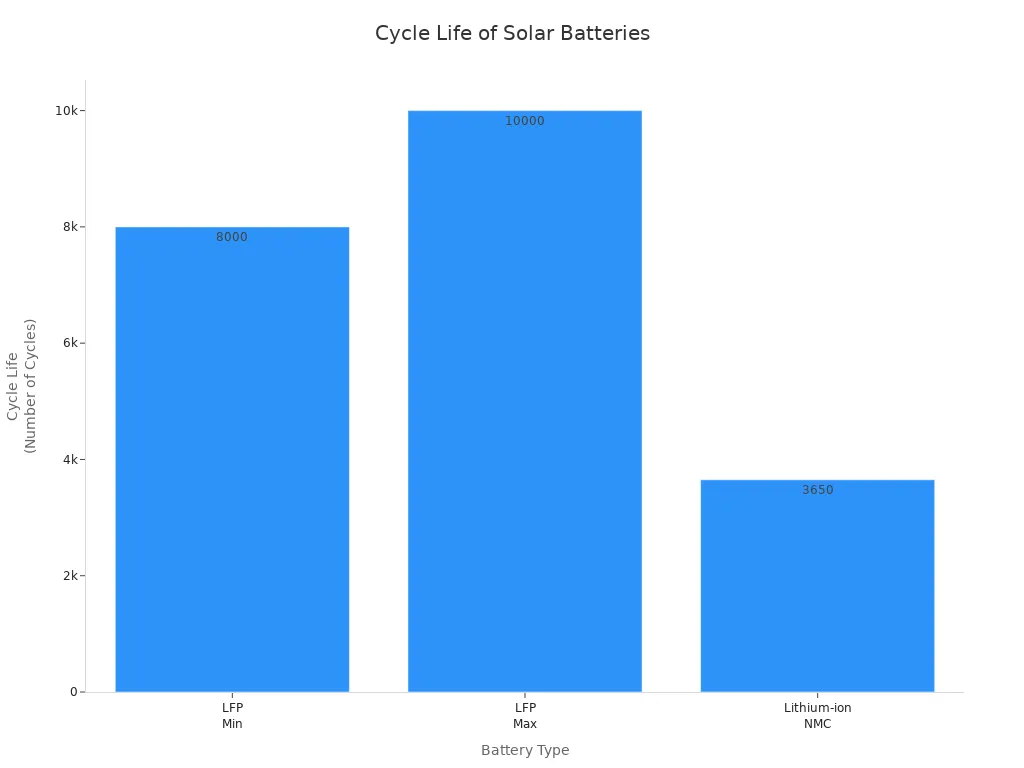
You can see LFP batteries last up to 10,000 cycles. This means you can charge and use them many times before they wear out.
Tip: If you want a battery that lasts long and needs little care, pick LFP or lithium-ion batteries for your solar storage.
Lead-acid batteries have been used for a long time. Many people know them from cars and backup power. They cost less at first but do not last as long as lithium batteries. You need to check water levels and keep them clean. They lose power faster if you use them a lot or if it is hot.
Some new solar batteries are starting to show up. Saltwater batteries use water and salt to store energy. They are safe and good for the planet. Flow batteries use liquid chemicals to hold energy. They last a long time and are good for big storage needs. These new types are not common in homes yet, but you may see them more soon.
Advanced systems like BEINENGStor use the newest battery technology. They give you more choices for solar storage. You can pick the type that fits your needs and budget.
You should look at the good and bad sides of each battery before you choose. Here is a table to help you compare the main pros and cons:
Battery Type | Advantages | Disadvantages |
|---|---|---|
Lithium-Ion | Longer lifespan (10-15 years), requires no maintenance, high energy efficiency (90-95%), enables greater solar energy utilization | Higher initial investment cost, efficiency may decrease over time, requires adequate space, complexity in installation and integration |
Lead-Acid | Lower upfront cost, familiar technology, some models require little to no maintenance | Shorter lifespan, may require maintenance, less energy efficiency compared to lithium-ion |
Lithium-ion and LFP batteries give you more value over time. They last longer and need less work. Lead-acid batteries cost less at first, but you may need to replace them sooner.
Here are some important things to remember about solar batteries:
Lithium-ion and LFP batteries are efficient and last long.
Lead-acid batteries cost less but need more care and do not last as long.
New batteries like saltwater and flow are safe and last long, but are not common yet.
Advanced systems like BEINENGStor use the best battery technology for solar storage.
When you pick solar batteries, think about how much energy you need. Think about how long you want the batteries to last. Think about how much care you want to give them. The right choice will help you get the most from your solar system and keep your home powered when you need it.
You can pick a new solar battery backup system. You can also add batteries to your old solar setup. New systems have the newest technology and work with most inverters. If you add batteries to an old system, you might need more planning. You may also need a new hybrid inverter. The BEINENG Home ESS works for both choices. You can put batteries on your current solar panels or get a whole new system.
Here is a table that shows the main things to think about:
Consideration | Retrofitting a Battery | Installing a New System |
|---|---|---|
Inverter Compatibility | May require new hybrid inverter | Typically includes compatible inverter |
Coupling Method | AC or DC coupling options available | Usually designed for optimal integration |
Battery Chemistry | Options like LiFePO4 for safety and lifespan | New systems can choose latest technologies |
Installation Complexity | May require additional planning | Generally more straightforward |
Adding batteries to an old system can cost less at first. But it might cost more later if your system is very old. New solar battery systems cost more when you buy them. But they work better and have longer warranties.
It is important to pick the right size for your solar battery backup system. The battery size should match how much energy you use. If your battery is too small, you might run out of power. If your battery is too big, you might spend too much money. The BEINENG Home ESS lets you store from 5 to 48 kWh in each stack. You can add more batteries if you need more power later.
Where you put your solar battery storage is important too. Put your batteries in a cool, dry place. Do not put them where it is hot or wet. Sunlight and weather can change how much energy you get. If your solar panels are in the shade, you will get less power. Make sure all parts of your system work well together. This stops problems and keeps your system safe. Some energy can be lost from old wires or old parts. This can lower how well your system works by 8% to 10%.
Tip: Always check what you need and local rules before you start installing your solar panel battery.
You can have a pro install your solar battery or do it yourself. A pro makes sure everything is safe and follows the rules. They do the electrical work, fill out forms, and connect your system. You also keep your warranties. Doing it yourself costs less and lets you pick where things go. But you could have safety problems or lose your warranty. You might not follow the rules.
Here is a table with the good and bad sides:
Installation Type | Pros | Cons |
|---|---|---|
Professional | No need for homeowners to handle electrical work. Ensures compliance with local regulations. Maintains manufacturer warranties. Experts manage paperwork and system integration. | Higher upfront cost compared to DIY. May require scheduling around contractor availability. |
DIY | Lower initial cost. Full control over system design and placement. | Potential safety risks. Voided warranties. Limited battery options and support. Non-compliance with local regulations could result in fines or system removal. |
The BEINENG Home ESS makes it easy to install solar panel batteries. You can use the myBeineng app to watch and control your battery backup system. This helps you see how much energy you use and manage your storage from your phone.
When you pick solar batteries, make sure they fit your needs. The right system helps you get the most from your solar setup. A system like BEINENG Home ESS lets you change as your energy needs grow.
You should check how much energy your batteries can hold and give. Capacity shows how much energy you can use at night or during an outage. Power ratings tell you how much energy you can use at once. If you want to run lots of appliances, you need a higher power rating.
Here is a table to help you understand the main terms:
Key Term | Description |
|---|---|
Usable capacity | The part of the battery’s total storage you can use. |
Depth of discharge (DoD) | The percent of the battery’s capacity you can safely use before recharging. |
Round-trip efficiency | The percent of stored energy you can actually use after charging and discharging losses. |
To figure out the size you need, check your daily energy use. Multiply it by how many days you want backup. Add about 10% for energy lost when charging. For example, if your home uses 30 kWh each day and you want two days of backup, you need about 66 kWh of storage.
Tip: Always match your battery size to your real energy needs for the best results.
Cycle life tells you how many times you can charge and use your batteries before they wear out. More cycles mean your batteries last longer. Warranties protect your money and help you feel safe.
Feature | Description |
|---|---|
Cycle Count | Shows how many times you can use and recharge the battery. |
Throughput Limits | Tells you how much energy you can get over the battery’s life. |
Warranty Duration | Most solar batteries have warranties from five to ten years. |
Exclusions | Some warranties do not cover all problems, so read the details. |
Prorating Practices | Warranty coverage may decrease over time. |
Pick batteries with high cycle counts and long warranties. The BEINENG Home ESS gives you strong cycle life and good support.
Your solar batteries should work with your solar panels and your home’s electrical system. Safety is very important. Always check for certifications and standards.
Certification/Standard | Description |
|---|---|
CE Marking | Shows the battery meets EU safety and environmental rules. |
UL 9540 | U.S. standard for fire safety and electrical hazards. |
IEC 62619 | Safety standard for lithium-ion batteries in stationary use. |
IEC 62933 | Covers safety and testing for battery energy storage systems. |
Pick batteries that meet these standards. This keeps your home safe and helps your installation pass inspections. The BEINENG Home ESS meets top safety standards and works with many solar setups.
Note: Always ask your installer about compatibility and safety certifications before you buy.
When you use battery backup with solar panels, you get more control over your energy. You can save extra energy on sunny days. You use this energy if the grid goes down. This keeps your lights and appliances working. The BEINENG Home ESS helps you store and use energy at home. You do not have to worry about blackouts or depend only on the power company.
The Energy Information Administration says there were over 1,500 weather-related power outages from 2000 to 2021. This shows why having battery backup is important for every home.
Solar battery backup lets you quickly switch from grid power to battery power. Smart systems can charge up before storms. This means you always have backup power ready. You get more value from your solar panels by using stored energy during outages.
Battery backup helps you spend less on electricity. You use stored solar energy when prices are high. This helps you avoid paying more during peak times. Many people save about 10% to 15% each year. One person in California saved about $1,240 by using battery backup for peak shaving.
You save solar energy during the day.
You use battery backup at night or when prices are highest.
You depend less on the grid and pay lower bills.
Solar energy storage systems like BEINENG Home ESS help you manage your energy and save money.
Solar battery backup helps the environment. You use clean energy instead of fossil fuels. This lowers your carbon footprint and helps the planet. Battery backup stores extra solar energy, so you can use it when the sun is not shining. This makes your energy supply steady and green.
Battery backup means you use less fossil fuel.
You get backup power without emissions.
Solar batteries give clean energy in faraway places.
Every time you install battery backup, you help make the future greener.
Battery backup can make your home worth more. Studies show homes with solar battery backup are more popular with buyers. People want energy independence and backup power they can trust. This makes your home more attractive and strong. The BEINENG Home ESS gives you even more benefits with its energy management features.
You get peace of mind, save money, and your home’s value goes up with battery backup.
When you get a solar battery backup system, you pay some money at first. You also pay to keep it working each year. All-in-one systems like BEINENG Home ESS can help you save money over time. They put solar, storage, and EV charging together. This makes it easier to install and can lower the cost for workers.
The first cost for a solar battery backup system is between $6,000 and $23,000. The price changes based on how big your system is, what batteries you pick, and how hard it is to set up.
You also need to pay for care each year. Most people spend $150 to $300 every year to keep their solar storage working well.
New systems do not need much care, so you save time and money later.
Tip: Pick a system with solar, storage, and smart controls for better value and less trouble.
You can pay less for your solar battery by using special programs from the government. Many states have programs to help you pay for solar storage. Here is a table with some popular programs:
State | Program Name | Incentive Details |
|---|---|---|
California | Self-Generation Incentive Program (SGIP) | Rebate per kilowatt for energy storage, with extra funds for high fire risk and low-income areas. |
Connecticut | Energy Storage Solutions | Up to $16,000 per home, plus more if you help the grid. Businesses get 50% upfront incentives. |
Massachusetts | Solar Massachusetts Renewable Target (SMART) | Stable pay for solar electricity, plus more through Mass Save Connected Solutions. |
New York | Long Island Incentive | $250 per kilowatt rebate for homeowners, but funds are running low as of early 2025. |
Ask your local power company or installer about programs you can use. These programs can make solar batteries cost much less.
You have different ways to pay for your solar battery. Some people use loans, leases, or power purchase agreements. The time it takes to get your money back is called the payback period. This is usually 6 to 10 years, but it can be as short as 3 years or as long as 12 years. Your payback time depends on:
How much you pay for electricity
The total cost for your system and setup
The programs and rebates you get
If you pay a lot for electricity or get good programs, you save money faster. Solar batteries help you save money and keep your home safe during outages. This makes them a smart choice for many families.
You want your solar battery storage system to last. Modern systems like BEINENG Home ESS make this simple. You do not need much time for upkeep. Most tasks are easy and need no special tools. Here is a table to help you remember what to do:
Frequency | Maintenance Task |
|---|---|
Monthly | Look for dust, debris, or pests. Check all connections. Keep the area around the system clear. |
Quarterly | Review how your system is working. Check for updates. Run a self-test using your system’s controls. |
Annually | Have a professional check the electrical connections. Test the battery storage capacity. Clean inside parts if needed. |
Tip: Use the myBeineng app to watch your solar battery storage system. The app helps you find problems early and keeps your system working well.
Keep the area around your batteries clean. Make sure nothing blocks the airflow. This helps your solar storage system work better and last longer.
Solar battery storage systems last for many years. Most lithium-ion batteries work for 10 to 15 years. Lithium iron phosphate batteries can last up to 20 years. You should plan to replace batteries before they lose too much power. Here is a table to help you know when to replace your batteries:
Battery Type | Expected Lifespan | Replacement Signs | Replacement Timing Pros and Cons |
|---|---|---|---|
Lithium-ion | 10-15 years | Less than 60% capacity, more failures, safety issues, warranty ends, new tech available | Early: Best performance, new warranty (Costs more) |
Lithium Iron Phosphate (LFP) | Up to 20 years | Same as above | End-of-life: Full value from battery (May see lower performance) |
Watch for signs your battery storage needs replacement. If you see less backup power or more errors, it may be time for new batteries. Plan ahead so your solar system always gives you reliable energy. Modern systems like BEINENG Home ESS make replacement easy and keep your home ready for the future.
Solar backup batteries help you use your own energy. They save you money and work when the power goes out. You can use more solar power and help the planet. The BEINENG Home ESS uses new technology and does not pollute. Think about how much energy you need before you buy a battery. Check your home and talk to a certified installer. They help you pick the best system and make sure it is safe. Solar batteries help you feel calm, keep your home safe, and help the earth.
Solar batteries do not need fuel and do not pollute. This makes your home safer and stronger.
Advantage | Description |
|---|---|
Energy Independence | Gives backup power and less need for the grid |
Cost Savings | Lets you use stored solar and avoid high prices |
Reliability During Outages | Keeps important things working in blackouts |
Most solar backup batteries work for 10 to 15 years. Some lithium iron phosphate batteries can last up to 20 years. You should check your battery’s health once a year.
You can add a battery to your solar system. Make sure your inverter works with battery storage. Ask an expert to check if your system is safe and compatible.
Your solar backup battery gives you power if the grid goes out. You can keep your lights and appliances on. Smart systems switch to battery power by themselves.
You can use apps like myBeineng to watch your battery. The app shows how much energy you use and warns you about problems. You can control your system from your phone.
Solar battery backup systems follow strict safety rules. They have fire suppression and temperature control features. Always pick certified products to keep your home safe.


Compact, quiet, and powerful, it keeps your essentials running during outages and lets you charge anywhere with solar power or grid power.
Perfect for renters who need flexibility without compromise.
Our estimator is only set up to provide preliminary estimates and installer information to residents of single family homes.