
 Email Us
 Contact us
 Whats App
Single family home

Commercial battery energy storage systems are being deployed faster than most industrial technologies in recent years. Factories, logistics centers, and grid operators are all integrating storage to manage energy costs and improve resilience. On the surface, the value is straightforward—reduce peak demand charges, stabilize power supply, and gain more control over energy usage.
But the reality behind these deployments is more complex. As installations increase, so do incidents. Thermal runaway, electrical faults, and system shutdowns are no longer rare events. In industrial environments, where systems operate continuously under load, even a small design flaw can escalate into a costly failure.
Many buyers still focus on capacity, price, and payback period. Safety is often treated as a secondary factor—something assumed rather than evaluated. That assumption is where problems begin.
Choosing a commercial battery energy storage system without understanding its safety architecture is a costly mistake waiting to happen. What appears to be a cost-saving decision at procurement can quickly turn into operational losses through downtime, maintenance, or even system replacement.
In practice, safety is not just about preventing accidents. It determines whether a commercial energy storage solution will generate stable returns or introduce hidden risks over time. Systems that fail under stress do not just stop working—they disrupt entire operations.
Battery systems combine high voltage and high energy density in a compact footprint. This creates a unique risk profile. Electrical faults can release energy instantly, and chemical instability can escalate quickly if not controlled.
Safety standards exist to manage these risks. They define how systems should behave under abnormal conditions, ensuring that failures are contained rather than amplified.
IEC 62271-200 focuses on high-voltage equipment design. It addresses internal arc faults, compartmentalization, and pressure management. In practical terms, it ensures that when a fault occurs, it remains confined within a controlled space instead of spreading.
CE certification ensures that the system operates safely within the broader electrical environment. It covers electromagnetic compatibility and electrical integrity, reducing the risk of interference or unexpected behavior.
MSDS documentation provides insight into material-level risks. It explains how battery components react under stress, including gas release and thermal behavior. This becomes critical during emergency response scenarios.
Without a solid safety framework, failures become unpredictable.
A factory once installed a low-cost system without proper fault containment. When an internal short circuit occurred, the fault propagated across modules. The system shut down completely, halting production for nearly two days. The financial loss far exceeded the initial savings.
In a commercial energy storage solution, standards are not formalities. They define how the system behaves when conditions are no longer ideal.
High voltage is often misunderstood. Many assume that higher voltage increases danger, but in engineered systems, it can actually improve stability.
A 512V system reduces current for the same power output. Lower current means less heat, reduced conductor stress, and improved efficiency. Over time, this leads to more stable operation.
A high voltage battery safety system is built on multiple layers, each addressing a specific type of risk.
Electrical protection reacts first. It detects overcurrent and short circuits, cutting off power before damage spreads.
Mechanical protection ensures physical separation. Insulated enclosures and reinforced connectors prevent unintended contact or environmental intrusion.
Interlock systems add another layer. A five-level interlock design prevents unsafe operations, such as opening enclosures under load or disconnecting live components.
System-level logic continuously monitors operating conditions. It detects anomalies and isolates affected areas before they escalate.
Modular architecture plays a critical role in safety. Instead of treating the system as a single unit, it divides it into independent sections.
Consider a warehouse running a commercial energy storage solution during peak hours. If one module overheats, a modular system isolates that unit while the rest continues operating. Without this design, the entire system would shut down.
This ability to localize faults is what makes high voltage systems not just efficient, but reliable.
Fire is the most severe risk in battery systems. Lithium-ion cells can release large amounts of energy rapidly during thermal runaway. In industrial settings, where systems are densely installed, the consequences can escalate quickly.
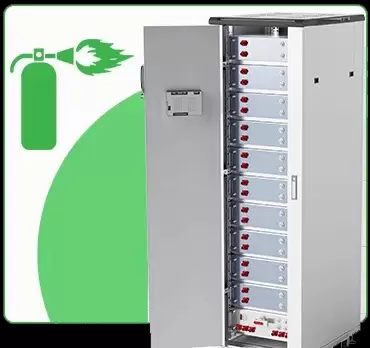
Modern systems integrate aerosol fire suppression directly into the battery enclosure. This is not an external add-on but part of the system design.
When sensors detect abnormal temperature or gas levels, the system triggers automatically. Aerosol particles are released into the affected area, interrupting combustion at a chemical level.
Unlike water-based systems, this approach does not damage electrical components or require large infrastructure.
Passive protection includes fire-resistant materials and physical barriers. These measures slow down fire spread but do not stop it.
Active protection intervenes early. It detects and suppresses fire at the source.
In a commercial energy storage solution, combining both approaches creates a more effective defense. Passive measures contain the risk, while active systems eliminate it before escalation.
Environmental conditions are often overlooked during system selection. However, temperature, humidity, and dust all influence how safely a system operates.
High temperatures accelerate battery degradation. Low temperatures reduce performance and can create uneven current flow. Moisture introduces the risk of insulation failure.
IP ratings define how well a system resists external elements.
IP55 provides protection against dust and low-pressure water, making it suitable for indoor industrial environments.
IP65 offers higher resistance, including protection against heavy water exposure. This is essential for outdoor installations.
A system designed for -30°C to 60°C can operate reliably in diverse environments. This includes mining sites, desert installations, and grid applications in cold regions.
One project in a high-dust industrial zone experienced repeated failures with a lower-rated system. After switching to a sealed commercial energy storage solution with higher IP protection, maintenance frequency dropped significantly.
Environmental adaptability is not just about durability. It ensures that safety margins remain intact under real-world conditions.
In industrial operations, downtime is more expensive than equipment. When a storage system fails, it disrupts production, logistics, and scheduling.
A well-designed commercial energy storage solution minimizes this risk by maintaining operation even during partial failures.
Safety directly affects long-term costs. Systems with poor protection require more frequent repairs and replacements.
In contrast, systems with robust safety architecture operate more predictably. Maintenance becomes scheduled rather than reactive.
| Risk Factor | Without Safety Design | With Advanced Safety System |
|---|---|---|
| Fire Risk | High and uncontrolled | Contained and managed |
| Downtime | Frequent interruptions | Minimal disruption |
| Maintenance | Reactive and costly | Planned and stable |
| Lifespan | Reduced | Extended |
Industrial buyers should evaluate how systems respond to faults, not just how they perform under normal conditions.
A commercial energy storage solution should be assessed based on containment, isolation, and recovery capabilities. These factors determine whether the system supports operations or becomes a liability.
Safety is not an add-on feature. It is built into the system architecture from the beginning.
A Modular High-Voltage Battery Energy Storage System integrates high voltage efficiency with multi-layer protection. The combination of interlock mechanisms, fault isolation, and fire suppression ensures controlled behavior under stress.
In industrial energy storage, safety is directly tied to financial outcomes. Systems that operate reliably reduce downtime, lower maintenance costs, and extend lifespan.
A commercial energy storage solution designed with safety at its core provides predictable performance over time.
In industrial energy storage, safety is not an option—it is the difference between profit and loss.
Systems that prioritize safety do more than prevent incidents. They protect operations, stabilize returns, and ensure that energy investments deliver value over the long term.


Compact, quiet, and powerful, it keeps your essentials running during outages and lets you charge anywhere with solar power or grid power.
Perfect for renters who need flexibility without compromise.
Our estimator is only set up to provide preliminary estimates and installer information to residents of single family homes.